NCAA Football
Why the Charles Bediako case could unleash chaos on college basketball, NBA Draft
Source
nytimes.com
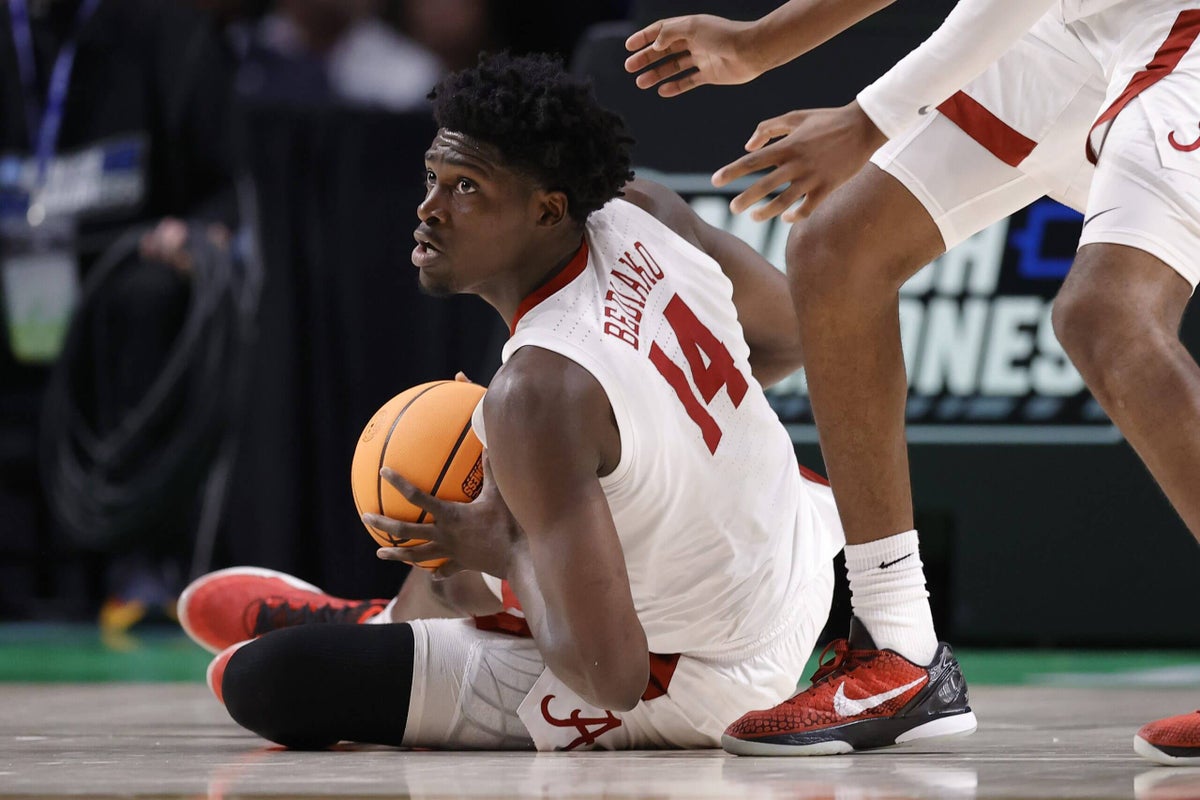
Charles Bediako is a center for the Alabama basketball team for the first time in nearly three years.
Well, at least for the next seven days, after Tuscaloosa County Circuit Court Judge James H. Roberts Jr. granted Bediako a temporary restraining order on Wednesday, a day after he sued the NCAA.
Beyond the absurd situational comedy of a player now being eligible to play college basketball after declaring for the NBA Draft three years ago and playing three seasons professionally in the G League, this case has drawn the eyes of everyone in the basketball community. It’s no exaggeration to say Bediako’s case could be the one that will tell us the future of the NBA, NBA Draft, college basketball and high school development across the United States.
To recap, for those not deep in the weeds here: Bediako is a 7-foot center who played for Alabama for two seasons, from 2021 to 2023. A member of the recruiting class of 2021 — that will be key later — he helped lead the Crimson Tide to a top-three defense nationally in 2022-23 before he declared for the draft. But he was never considered a very interesting professional prospect; at no point did I or anyone else with legitimate insight into the NBA Draft process think Bediako would be selected. I think I was highest on Bediako of any draft experts because of his defense; I still had him ranked 71st in my 2023 NBA Draft Guide. Unfortunately for him, there are only 60 slots in the draft.
Bediako — who averaged 6.6 points and 5.2 rebounds in his Alabama career — chose not to use his two remaining collegiate years to improve his draft standing, unlike one of his contemporaries, former Creighton center Ryan Kalkbrenner, who was the 34th pick in last summer’s draft and is in the Charlotte Hornets’ rotation.
Bediako made a poor choice in 2023, whether that was of his own volition or based on bad advice. But because he’s still within his five-year eligibility clock window — one area that the NCAA has consistently won in court — he technically still has a semester of eligibility remaining.
That’s what makes his situation drastically different than the G League or overseas professional players who have recently been granted college eligibility, such as Baylor center James Nnaji coming from overseas or Louisville guard London Johnson coming from the G League. Neither of them previously played college basketball. Bediako is now crawling back to campus because his professional career hasn’t gone the way he’d hoped, as he averaged five points per game in the G League this season. His attempt to return threatens to tear apart the fabric of the tenuous detente between the NBA and college basketball, which have long allowed the two groups to exist as separate, but mutually beneficial entities.
NCAA president Charlie Baker released a statement on Dec. 30 that said, “The NCAA has not and will not grant eligibility to any prospective or returning student-athletes who have signed an NBA contract (including a two-way contract).” Bediako has signed three NBA deals: two Exhibit 10 contracts and one two-way contract.
The issue that both the NBA and college basketball sources are watching most closely is the early-entry deadline question. Can a player keep his name in the draft past the NCAA’s early-entry deadline and still maintain his eligibility?
If Bediako is allowed to play and the judge creates a precedent that the NCAA cannot enforce its early-entry deadline dates, that would create a kind of anarchy that even Jon Rothstein wouldn’t enjoy or appreciate. Essentially, it would potentially create a world of free agents within college basketball who could sign anywhere — including the NBA — at any given time.
Let me walk you down this road.
If the collegiate early entry date means nothing, a significant portion of players in the country should declare for the draft after their freshman year. Why? Because if they went undrafted, it would be advantageous if they broke out later in their college career.
Let’s use Golden State Warriors guard Brandin Podziemski, a player who was also in Bediako’s 2023 NBA Draft class, as a case study.
Podziemski won the Wisconsin Mr. Basketball award in high school but struggled immensely in his freshman year at Illinois in 2021-22. He averaged 1.4 points per game and was in and out of the Illini rotation. He clearly would not have been drafted in 2022. But then Podziemski transferred to Santa Clara, where he averaged nearly 20 points, nine rebounds and four assists per game.
Imagine a world in which Podziemski had declared and gone undrafted after his freshman year, thus becoming an NBA free agent in the midst of that sophomore year breakout. On Jan. 28, 2023, Santa Clara was 16-7 with home losses to San Jose State and Pacific, two teams ranked at the time outside of the top 100 in KenPom’s database. The Broncos had no chance to make the NCAA Tournament unless they won the WCC tournament, likely having to beat top-15 teams Saint Mary’s and Gonzaga along the way.
At that point, Podziemski would have had myriad offers from NBA teams. He was already seen by many — although stupidly not by yours truly at the time — as a potential first-round pick by the time February rolled around. Given that he was playing at Santa Clara, he wouldn’t have been making enough money via name, image and likeness rights to stop him from leaving his team midseason for an NBA minimum contract — if not more. In this example, it would have been irresponsible for Podziemski not to leave Santa Clara midseason and sign with an NBA team — thus totally cratering the Broncos’ season.
You can certainly make the case that such a situation would have been advantageous for Podziemski, as he could have departed and made copious amounts of money. But what’s best for that player is not what’s actually best for college basketball — or the NBA’s competitive balance, for that matter. Does the NCAA really want its top players leaving in the middle of the season to go pro? And does the NBA want college basketball players to be able to sign with whatever team they want in-season?
Regardless of your opinion on the NBA Draft and whether it should exist — many, including my Basketball Hall of Famer colleague David Aldridge, don’t — it seems pretty clear the NBA values the competitive balance opportunities the draft presents. League officials would not have wanted Podziemski, for example, to sign in the 2023 midseason with his hometown Milwaukee Bucks, who were on their way to a 58-win season.
You might wonder whether this type of scenario would occur frequently enough to count as a problem. After all, for years, international prospects who have gone undrafted have had the freedom to sign wherever they wanted after the fact. But I don’t think that applies to this situation. As any NBA executive will tell you, European prospects are out-of-sight, out-of-mind during the season unless they are draft-eligible. Teams just don’t have enough manpower to have full-scale scouting apparatuses overseas, so players like this get lost in a way they wouldn’t in the media-laden environment of college basketball.
You also might make the case that we’ve seen a situation like this before. Many remember the great Randolph Morris debacle of 2005, when he declared for the draft without an agent and went unselected. The NCAA ruled that because he did not sign a professional deal and did not hire an agent at the time, he was eligible to play for Kentucky again after sitting out the first half of the 2005-06 season. He ended up making first-team All-SEC as a junior in 2007 before signing as a free agent with the New York Knicks in March 2007 season — the same week the Wildcats were eliminated from the NCAA Tournament.
The difference between then and now, though, is that nearly all players have agents. Despite what Marquette coach Shaka Smart might say, that’s a good thing. Players should have people looking out for their best interests. However, I’m not sure it’s been publicized just how widespread representation is at the collegiate level. There are players in mid-major leagues whom fans would be stunned to learn have NBA-certified agents. Many high school players committed to play at mid-major schools next year have agents. Smart agents would see the advantage of their clients going undrafted and would advise them to try to do so.
Now, there is a bit of game theory to consider. Players who hold real NBA interest after their freshman season would need to be careful, as being drafted later in the second round while an NBA team holds your rights would be disadvantageous to your long-term contractual situation. For instance, 2022 NBA draftees like Jaden Ivey, Bennedict Mathurin and Keegan Murray would have all been picked a year earlier. But those players who are not considered draftable early in their careers should go ahead and declare. More players like this end up as first-rounders than you might think. Just imagine stars like Damian Lillard, Jalen Williams and Donovan Mitchell — all of whom turned into lottery picks and none of whom would have been selected had they entered the draft after their freshman years — being available on the open market.
This would likely require the NBA to adjust its draft eligibility system. The league might need to institute a rule declaring that any player who goes undrafted and plays in college the following season would re-enter the draft pool the next year. There would need to be specified dates, but something along those lines would solve many of the above issues.
Don’t sleep on the impact this would also create on college basketball’s offseason, when coaches would have much less control over their rosters until late July.
Why late July? Well, an undrafted player could try to make a pro roster by participating in NBA Summer League, knowing he could still return to school. (And the question as to whether playing in a summer league constitutes signing an NBA contract appears to have been decided by the NCAA with its decision to make Nnaji eligible.) And in most cases, the kinds of players that NBA teams would sign for their summer-league teams would be the best players with remaining collegiate eligibility, meaning that schools would be held hostage until NBA rosters were finalized.
Another idea that has been pitched to me by NBA team sources is the idea of using colleges essentially as farm systems. For example, could the Los Angeles Lakers draft players who are in the transfer portal and ship them to USC or UCLA to closely follow their development without having to actually pay them? It would require alignment across the university, the NBA team and with player agencies. But that would be the next logical step here, with colleges being more at the whim of NBA developmental practices.
Colleges would be incentivized to pay their star players enough money to stop them from participating in NBA summer activity, thus creating more roster certainty with their team. That’s already happening. For example, Texas Tech incentivized JT Toppin to not go through the NBA Draft process last year by paying him more than $3 million.
But undeniably, this would be complicated and would have trickle-down effects on the rest of the basketball ecosystem. If you’re not certain how many players you’ll have on your roster, you don’t know how many recruits you can offer. The players who would be most adversely affected are high school seniors, as schools would likely not be as willing to offer younger, more developmental players before knowing what the rest of their roster looks like.
These are some of the stakes of the Bediako case. If he ultimately wins, basketball at every level will enter a new era that will require significant adjustments from everyone involved.