NBA
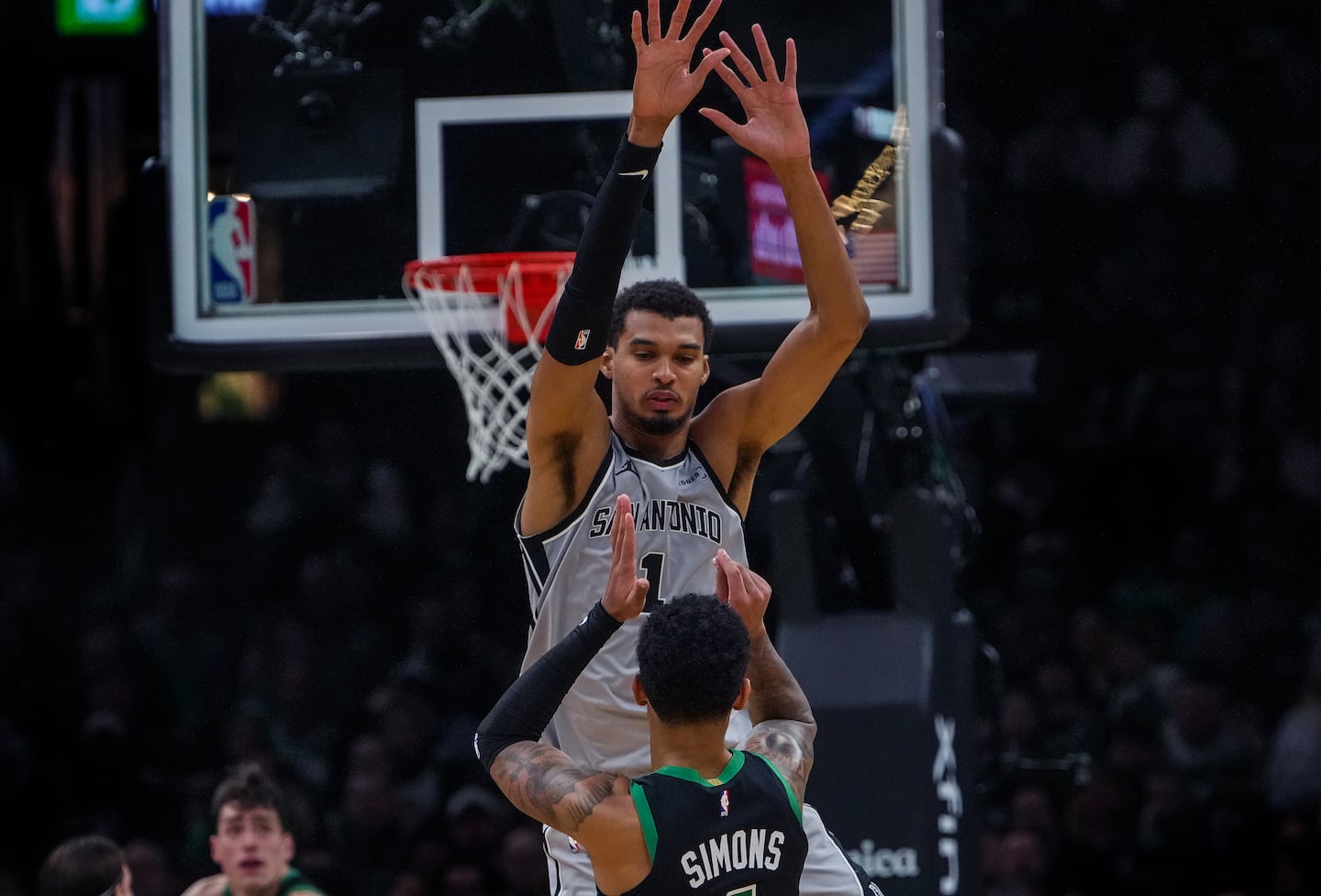
Who’s got next as face of the NBA when LeBron James retires? It’ll be Victor Wembanyama’s game.
Source
bostonglobe.com
Wembanyama is unquestionably different, not only because of his 7-foot-4-inch frame paired with point guard skills. He is unique because he is a thinker, appreciative of his opportunity to play in the NBA yet determined not to just be one of the guys, but to be the best.
It was his fire and passion that sparked his World teammates and USA opponents into playing the most competitive midseason game in more than a decade and resurrected hope that All-Star Weekend should continue in its current form.
Perhaps of the many accomplishments Victor Wembanyama will amass during what is expected to be a brilliant career, saving the NBA All-Star Game will be one of them.
He respects the greats. He has been tutored by the likes of Spurs greats David Robinson and Tim Duncan but Wembanyama gives the sense that he wants to be his own megastar, considered amongst those all-time greats despite being just 22 years old.
There has been debate about who will become the “face of the league” when LeBron James retires. Wembanyama is the top candidate, without question.
“I guess chasing greatness is subjective,” he said. “I’m definitely chasing my own greatness. I’m very much pursuing it, actually. Every day trying to push myself out of my comfort zone and do hard things.
“I think the first step, in my opinion, to greatness every time is what you can do in the moment. You don’t have to think about where you’re going to be in 20 years, but you have to think about being the best in the next moment, the next game, the next 24 hours. So you could say I’m chasing greatness, yeah.”
His All-Star performance was impressive but even more impressive is his propensity to lead, to have enough brashness to set his own course. James has often been blamed for the decline of the All-Star Game because he did not implore his teammates to give 100 percent in the game, and he became the primary league mentor following the retirement of Kobe Bryant.
That is a slight criticism of James, but he should be lauded for setting the course of off-court behavior for stars, wrapping up a stellar career with his image intact. The lone debate is whether he is the game’s all-time greatest player.
“I actually think LeBron has some — he’s very intelligent in these areas,” Wembanyama said. “Him obviously being the face of the league. Having very few mistakes, PR mistakes. I think that definitely takes some intelligence.
“I think there are many things to take from him. I’ve never had the chance to spend time with him, to have full discussion, but I would love to. I don’t know how many millions of basketball players there are on Earth, and all of them can learn something from LeBron.”
Wembanyama said being in San Antonio, a franchise with five titles and two previous franchise cornerstones in Duncan and Robinson, has helped his NBA transition.
“In my franchise, in my city, I’ve been welcomed from Day 1 as if I had been there for 20 years,” he said. “So the Spurs’ city, the people, San Antonio, and the Spurs fans really make it, like, there’s no pressure. They really make it like I’m part of the family, so they make me super comfortable. The difference is at home people know where we live, people know where we go every day, and they’re still not intrusive.
“There’s no pressure about being a franchise player. First overall pick, that’s something I’m super proud of and something I’ve literally spent 19 years of my life trying to reach. So I mean, I’m here for all of it and everything that comes with it.”
While All-Star Weekend is about celebrating the game, it has also evolved into the league addressing its major issues and tanking is one of those issues. Commissioner Adam Silver was relegated to fining the Jazz and Pacers for intentionally trying to lose games — by either resting or benching healthy players and allowing opponents to gain an advantage.
Not only are fans upset by teams intentionally trying to lose but what about bettors, who have become a major priority for Silver and the NBA since the league decided to partner with betting sites. He promised to address this situation but there is no easy solution when there is more incentive to lose.
For generations, the teams with the worst records have gained the best draft picks. Teams who are poorly run get added benefits for being terrible. It’s nearly impossible to pull off what the Celtics have done, reaching the playoffs the last 11 seasons without a stretch of losing seasons.
Of course, the Celtics’ trade with the Nets in 2013 ensured Boston would compete for several years, but management did have to have the foresight, and brilliance, to trade down to take Jayson Tatum in 2017 instead of using the No. 1 pick on Markelle Fultz or Lonzo Ball, and to pick Jaylen Brown over Kris Dunn, Buddy Hield, and Dragan Bender in ′16.
So should the better-managed teams always have to take a step back to allow those who are mismanaged get a chance to catch up, which for some franchises never happens?
“I’ll just use the colloquial ‘tanking’ term,” Silver said. “Yes, it’s been part of this league for a long time. Back in the 1960s, there was a coin flip. At some point, I think it was in the 1980s, we moved to a lottery. That lottery has been changed I think roughly five times over the years to stay ahead of some of the behavior of our teams.
“The incentives are not necessarily matched here. I think the tradition in sports where the worst-performing team receives the first pick from their partners, when any economist comes and looks at our system, they always point out you have the incentives backwards there. That doesn’t necessarily make sense.”
Silver pointed out that in the olden days, teams were actually trying not to be bad. It was embarrassing to be a yearly participant in the draft lottery. The worst teams were the worst because of mismanagement or they dealt with injury misfortune/underachieving players.
Nowadays, teams have discovered that the best path to success is to hit rock bottom first, and the 76ers decided a decade ago to avoid signing quality players for multiple years to rebuild their franchise through the draft. Unfortunately for them, selecting Joel Embiid, Ben Simmons, Jahlil Okafor, and Fultz — two No. 1 picks and two No. 3s — has not even resulted in an NBA Finals appearance. And Simmons, Okafor, and Fultz are out of the league.
The Process failed. But teams are eager to undress their franchise for multiple seasons for the chance at a title shot. But for a franchise such as the Jazz, when does it end?
“I think what we’re seeing is modern analytics where it’s so clear that the incentives are misaligned,” Silver said. “Are we seeing behavior that is worse this year than we’ve seen in recent memory? Yes, is my view. Which was what led to those fines, and not just those fines but to my statement that we’re going to be looking more closely at the totality of all the circumstances this season in terms of teams’ behavior, and very intentionally wanted teams to be on notice.”
Unlike other sports leagues, the NBA has established a culture where just making the playoffs as an average team is frowned upon. NFL or MLB teams don’t tend to intentionally lose to get a draft pick until the tail end of the season. But no NBA team wants to be the current Heat, a team that is good enough to reach the playoffs but never good enough to win a championship. Teams would rather be in the lottery than an eighth seed and that’s what Silver has to address.
Silver sent a memo to all 30 teams saying that there will be changes to the current system of how its members are aligned to select players. It’s been a long time coming.
A surprise entry into the NBA’s 3-point contest at All-Star Weekend was Trail Blazers guard Damian Lillard, who is expected to miss the season with a torn Achilles tendon. He was not only healthy enough to compete but won his third contest despite not playing for nearly a year.
It was one of the more heartwarming stories of All-Star Weekend. Lillard defeated seven competitors, including Suns sharpshooter Devin Booker in the final.
Lillard, 35, plans to return to the Blazers healthy next season but the fact he returned for All-Star Weekend and flourished despite still rehabilitating is perhaps motivation for others recovering from the same injury, such as the Celtics’ Jayson Tatum.
“Every day I’m up early in the morning, warming up and shooting the ball,” Lillard said. “Off the dribble, catch and shoot, every style of shot you can shoot, I’m shooting them every day, hundreds of them. I knew that this would not be an issue for me. I can’t say I knew that I would win because you just never know, but I knew I would be able to be strong out there and have a chance to.”
Lillard acknowledged he looked to this competition as a carrot in a sense for all of his months of rehabilitation, an opportunity to battle against his brethren, wearing his original NBA uniform with the franchise that coveted him for more than a decade.
Achilles rehabilitation has changed dramatically in the past decade. Once considered a career-ending injury, including for all-time greats such as Isiah Thomas, players can return at full strength and with confidence in their bodies. The Rockets’ Kevin Durant is seven years removed from his Achilles tear and playing at an All-NBA level.
“I think modern medicine is definitely part of it; it’s not the injury that it used to be, and I know that from my personal experience and how I feel now,” Lillard said. “It’s definitely not what it was. I think we are continuing to learn more and more about it, how to recover from it, how to make it stronger, how to prevent it, all of those things, especially people that go through the injury. It’s something you can come back and have another prime from, especially if you’re a hard worker. I’ve been talking to [Tatum] and it’s all he cares about is, I’ve got to get healthy and I’ve got to be me.
“Like for me, everybody was like, ‘Oh, that’s a tough injury, and what are you going to do?’ And in my head, I was like, I’m going to do what I always do. Then once I started to learn and I knew it wasn’t just in my mind, like a reality for me to be who I am once I’m healthy and I saw that it was physically possible, that was all I needed. I think any of the guys that have experienced it the same as I have, I’m sure they see the same thing. It’s more encouraging than discouraging.”
This reporter asked Lillard if he felt as if he was playing for something bigger than himself, the legion of athletes from the NBA courts to field hockey turfs to pick-up blacktops who have torn their Achilles and are determined to return to previous form. He giggled at the question but his response was profound, serving as motivation for anyone going through physical adversity.
“I wouldn’t say I’m representing Achilles nation or nothing like that,” he said. “I do think I represent strength. We are athletes, so when we go through injury, people act like it’s the end of the world because people are used to us being lifted up and everything being about us. But people go through way worse. They carry on, and they continue to move forward and experience worse things than an injury. For me, it was more about representing strength for people that don’t just — not just Achilles, but when something bad happened, I was waived [by the Bucks], I’m hurt, I can’t play, I didn’t know what was going to happen, but I didn’t choose to be weak about it. I picked myself up, and I just kept stepping and kept marching.
“Anytime I’m in that type of situation, that’s what I’m thinking is, like, how do I represent what I come from, the kind of family I come from, the kind of people I come from, the kind of city and neighborhood I come from. That’s who I’m representing in this journey. It’s not just about my Achilles. It’s just about not being weak. You can choose either one. You can choose to feel sorry for yourself and go out weak, or you can represent what strength really is, or you could take that path to be weak.”
The Timberwolves re-signed Mike Conley two weeks after trading him. Want to know how? Well, they sent the 38-year-old point guard along with former lottery pick Rob Dillingham to the Bulls in a cost-cutting trade. The Bulls then sent Conley to the Hornets for Collin Sexton, and Conley was waived. Since Conley had been traded twice, he was eligible to return to his original team. Minnesota needed Conley’s experience but he lost his starting spot as the club shifted Donte DiVicenzo to the point. The club gave up on the once-promising Dillingham, who will get an opportunity in Chicago. Conley had been a 40-plus-percent 3-point shooter in his Timberwolves tenure but that number dropped to 32.1 percent this season, although he did hit a key triple to help beat the Celtics in November … Cooper Flagg missed the Rising Stars Game because of what was diagnosed as a midfoot sprain. But he did make an appearance at the league’s tech summit during All-Star Weekend along with former Duke teammate Kon Knueppel. The sprain is not considered to be serious but it’s uncertain whether Flagg will be healthy enough for his much-anticipated debut game at TD Garden against the Celtics. The Mavericks are likely headed for the lottery but there is incentive for Flagg to continue to play through the season as he is the rookie of the year front-runner and needs to play in 16 of the Mavericks’ final 28 games to be eligible for the award. Knueppel is pushing Flagg for the award with the Hornets’ recent success … The Bucks signed Cam Thomas after he was waived by the Nets to become a spark off the bench and help Milwaukee make a playoff push, and it’s been a successful transaction so far. Through three games, Thomas is averaging 16.7 points in less than 20 minutes per game and scored 34 in a win at Orlando. Thomas is only 24 and has proven to be a high-volume scorer but his shot selection and defense have been criticized over his career … The National Basketball Players Association named David Kelly as its executive director, replacing former player Andre Iguodala. Kelly previously served as the managing director and legal counsel for the NBPA, after working for the Warriors.
Gary Washburn is a Globe columnist. He can be reached at gary.washburn@globe.com. Follow him @GwashburnGlobe.