NCAA Football
What does Darian Mensah spurning Duke late in transfer portal mean for college football?
Source
nytimes.com
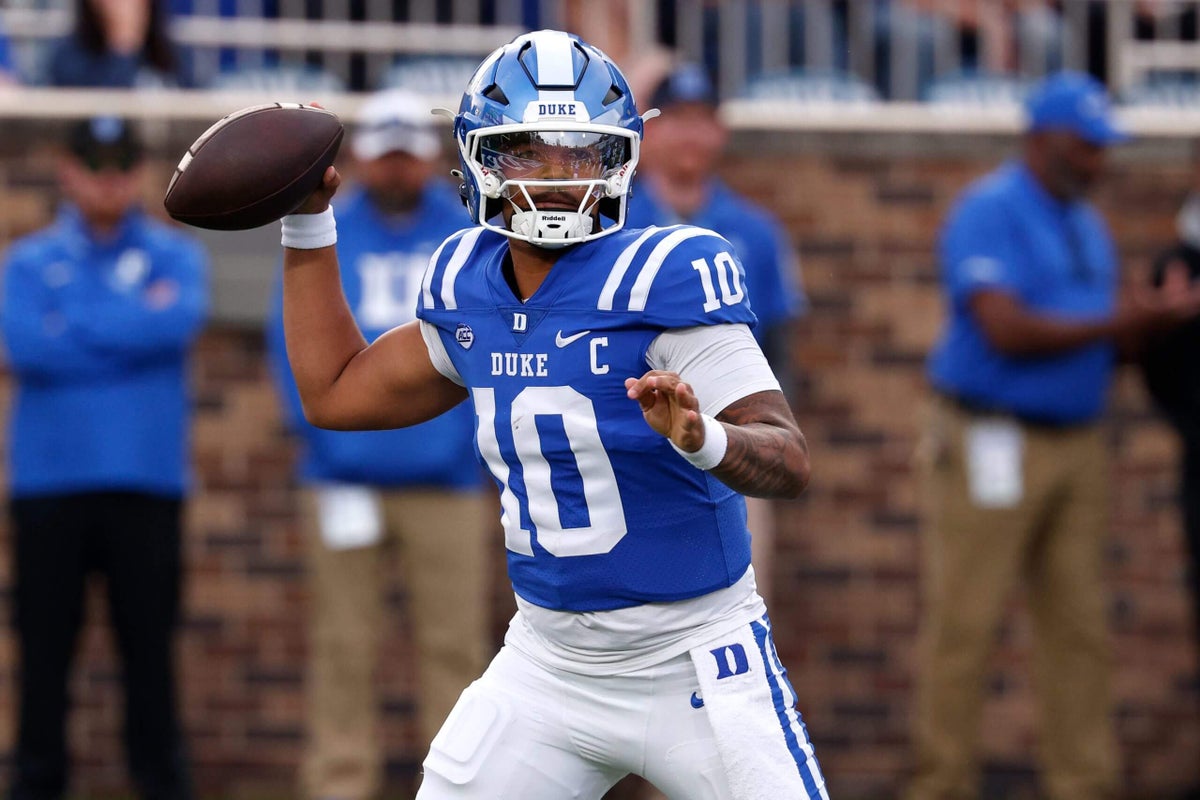
Hours before the college football transfer portal window closed Friday and about a month after he said he was staying with his current team, quarterback Darian Mensah announced he is leaving Duke after a season in which he was a huge part of why the Blue Devils won the ACC for the first time since 1989. The Tulane transfer threw 34 touchdown passes and just six interceptions.
It sounds like he’s eyeing a potential move to Miami, which missed on Sam Leavitt (LSU), Ty Simpson (NFL) and Brendan Sorsby (Texas Tech).
We’re used to seeing quarterbacks like Mensah leave. But this one feels different.
What was your initial reaction?
Khan: As the closing of the transfer portal window approached, I kept wondering what big surprise was around the corner, because there’s always one. There were quarterback-needy teams out there, but most of the top transfers have signed or committed. The question was who could be coaxed into the portal this late in the window?
I was surprised it was Mensah. Knowing he was on a two-year deal, had already announced his return and was being well-compensated ($3 to $4 million), I figured he was set. My next reaction was to think, “What does Duke do now?” The ACC champions are in a tough spot. There are still options in the portal, but most of the remaining ones are unproven and inexperienced, have washed out elsewhere or are from the Group of 5 or FCS.
Why are schools so … desperate?
Ubben: I always say the only thing in college football more expensive than winning is losing. If you’re paying $20 million for a roster and $10 million for a coach and go 7-5 at a place with big expectations, it’s hard to imagine many things more wasteful. But if you’re paying $25 million for a roster and $12 million for a coach who goes 11-1, plays for a conference title and goes on a Playoff run, it’s a legit bargain compared to what the university can earn in exposure, donations and growth in enrollment. It’s why I always argue Nick Saban was wildly underpaid at Alabama. His value to the university was so much more than his $10 million-plus salary.
We’re seeing this dynamic play out with players now. A bad football team is now a problem that can be directly fixed by money, but it requires a lot of good people in the building on the field and on the sidelines, too. In this case, it’s all about the quarterback. There weren’t enough in the portal to satisfy the deep-pocketed teams looking for one. Now, Mensah has put his services on the market, and it’s the same thing as a fantasy football auction or the NFL Draft. When there’s a shortage of talent at an important position, the price is going to exceed what that player is probably worth because of what he could be worth to the team he joins.
What does this say about power dynamics?
Ubben: The schools still have lots of power, but players who are productive have so much leverage. And if they’re productive players at a premium position where there’s a shortage of supply on the market, players have an impossible amount of leverage to force schools to do almost anything. It’s very similar to the coaching carousel and mostly driven by supply and demand. Quarterbacks and big-time linemen are going to be the most coveted assets on the market every year.
Khan: Because the schools and conference refuse to make the players employees. A large part of why we’ve landed here is the absurdity of trying to say that these contracts are not “pay for play.” Ever since the institution of NIL — and well before — the NCAA and school and conference leaders have resisted athlete employment. Well, the courts have made it pretty clear that you can’t put employee-like restrictions on players without giving them employee status, unless you have an antitrust exemption.
What’s the simplest explanation for why this feels different than past departures? We’ve seen big-time QBs leave before.
Morales: It feels worse or more costly for Duke because of a couple of factors. The first being timing. The portal closed on Friday, and the Blue Devils just lost their starting quarterback. It’s not like they can easily add a proven quarterback now because a lot of those guys are off the board and they can’t lure someone into the portal because it’s closed. And it’s the most important position in the sport and only one plays. If this was a receiver, it’s like, “All right, not great, but we have six or seven other guys on the roster we can turn to.” But this is quarterback, where viable options are hard to find.
Ubben: To me, it exposes how little power the schools have. Duke did everything it could do. It signed Mensah to a multi-year deal. It got a commitment from him last month to stay. It’s paying him at the top of the market at $4 million. And now someone is willing to reset the market out of desperation. I get the decision. I don’t begrudge Mensah for it. But it’s so bad for the sport, which is as good as ever on the field and as bad as ever off the field.
Morales: I feel bad for Duke. But at the same time, I don’t. You have to know who you’re doing business with. One of the main talking points when Mensah transferred there last year from Tulane was how much money he was making, just like when Nico Iamaleava originally signed with Tennessee. You can’t be surprised when these players who sign with you because of these big money deals leave and look around for more.
Why couldn’t he just go into the portal earlier? He announced he was coming back last month? What changed?
Ubben: When college football moved to a single portal window, it (probably … mostly) did away with the trend of players signing with schools in the winter window, going through spring practice and re-negotiating with those schools or looking for a better deal elsewhere just a few months later.
But now, we’re seeing a troubling trend of programs trying to navigate the portal, missing on options and seemingly luring players into the portal late in the window and screwing over the programs they’re leaving behind. We saw this earlier this week. Offensive tackle Jordan Seaton looks like a possible future top-five pick and might be the best player in the portal. He was locked in with Colorado. He was helping recruit to the program as recently as last week. But now he’s taking visits. Perhaps there are other reasons, but everyone has a price, and when the market drives up the price enough, it can force players who would like to be loyal to their teams to make decisions that are loyal to their actual families.
Tennessee tried this tactic last year after it lost Iamaleava but basically struck out and turned to Joey Aguilar, the player UCLA recruited Iamaleava over. But it was a tougher sell in the spring window to make players jump when they’d be doing so and missing spring practice.
But convincing a player to leave on April 16 is way different than convincing a player to leave on Jan. 16.
Khan: Having a single portal window made sense to me — that’s how it is in the other college sports — but this is an unfortunate byproduct of it. Losing a player at the 11th hour is tough.
But schools know they have only one shot to get the players they want, and if they miss, they’re scrambling by trying to flip players who have committed elsewhere but haven’t signed or trying to convince someone who’s not in the portal to jump into it. If you don’t get who you want or need, fans aren’t going to just say, “Oh well, tough season, they missed on their portal guys.” The pressure is immense and transactions like this are a direct result of said pressure.
Will the ACC get involved?
Earlier this month it looked Washington quarterback Demond Williams Jr. was headed to the portal days after he signed a revenue sharing deal with the school, but the Big Ten made it clear it would be involved in the legal battle over Williams’ contract.
The exact contractual details ahead of Mensah look unclear for now, but a source with knowledge of the details said there was no buyout. Still, could we see the ACC taking a similar interest in intraconference portal shenanigans?
Russo: College sports leaders have been pleading with lawmakers in Washington, D.C., for federal legislation and some antitrust protection to allow the NCAA and conferences to curtail the constant free agency with rules and regulations over transfers that judges can’t strike down. There was some hope for a bill, the SCORE Act, to pass the House of Representatives late last year, but that stalled before getting to a vote. Now heading into a mid-term election year, the chances to get something done in Congress before next fall don’t seem particularly hopeful.
Morales: The ACC can’t even figure out the best way to determine who can play in its conference championship game. I can’t wait to see how it tries to tackle this. What are the transfer portal tiebreaker scenarios?
It is funny though how we can trace most chaos back to Lane Kiffin, though. If Miami ends up landing Sam Leavitt, does this happen? Probably not. But it would’ve just been LSU luring someone into the portal, not Miami. The Hurricanes’ miss is likely how we ended up here.
Khan: If Mensah ends up at Miami, I’d have to think ACC commissioner Jim Phillips is going to have something to say about it. There was some talk earlier this week at the NCAA convention about the idea of conferences governing themselves, with some administrators pointing out to Yahoo Sports that it’s a lot easier to enforce rules across a single conference rather than 136 FBS teams (and it’s easier to get done legally, to avoid running afoul of antitrust laws).
That seems extreme, but I also see the logic in it. Regardless, conferences being able to manage their own seems like a reasonable baseline expectation. I’m interested to see how Phillips approaches this.
Can this be fixed? How?
Morales: Congress has, uh, a lot on its hands right now. So putting all your hopes on that seems pretty unwise at the moment. And apparently we can’t count on the parties involved to fix anything themselves, so your guess as to how it gets fixed is probably as good or better than mine.
Ubben: A collective bargaining agreement would absolutely bring some level of rationality to the sport, but I’m skeptical anything resembling a players association would sign off on something that severely limited player movement. It could feature ironclad multi-year contracts if players are willing to sign them, but players are always going to want freedom. Maybe they would trade some of that freedom to get something else in a hypothetical future CBA negotiation. Player movement is not an issue in professional sports, and those moves are way less complicated than in college where (hold your laughter, please) academic concerns are a factor, too.
After it seemed like the Williams contract held up at Washington and Texas Tech needed to pay Cincinnati a buyout to get Sorsby, I’m very curious if schools or collectives will install hugely punitive buyouts in the future for high-value players. If your school wants to hire Indiana coach Curt Cignetti tomorrow, it not only has to get him to say yes, but it has to pay Indiana $15 million before it pays Cignetti a cent. That’s good business and a fair deal Cignetti agreed to sign.
I suspect we’ll see some big buyouts in the future to prevent situations like these. Mensah would have the leverage to not sign one now, but a year ago, he’s taking a two-year, $8 million deal no matter what it would cost him to leave Duke if he wanted to do so. If a program has leverage on a player to lock him into a buyout, I don’t see why they wouldn’t at least try.
Colorado losing Seaton and Duke losing Mensah this late in the process leaves those programs massively kneecapped.
Khan: It’s going to be messy for a while. None of the proposed solutions are easy to implement, nor can they be done quickly. Unfortunately, it could get a bit worse before it gets better.