NCAA Football
Indiana title run stands alone and shows how college football has changed, plus more CFP takeaways
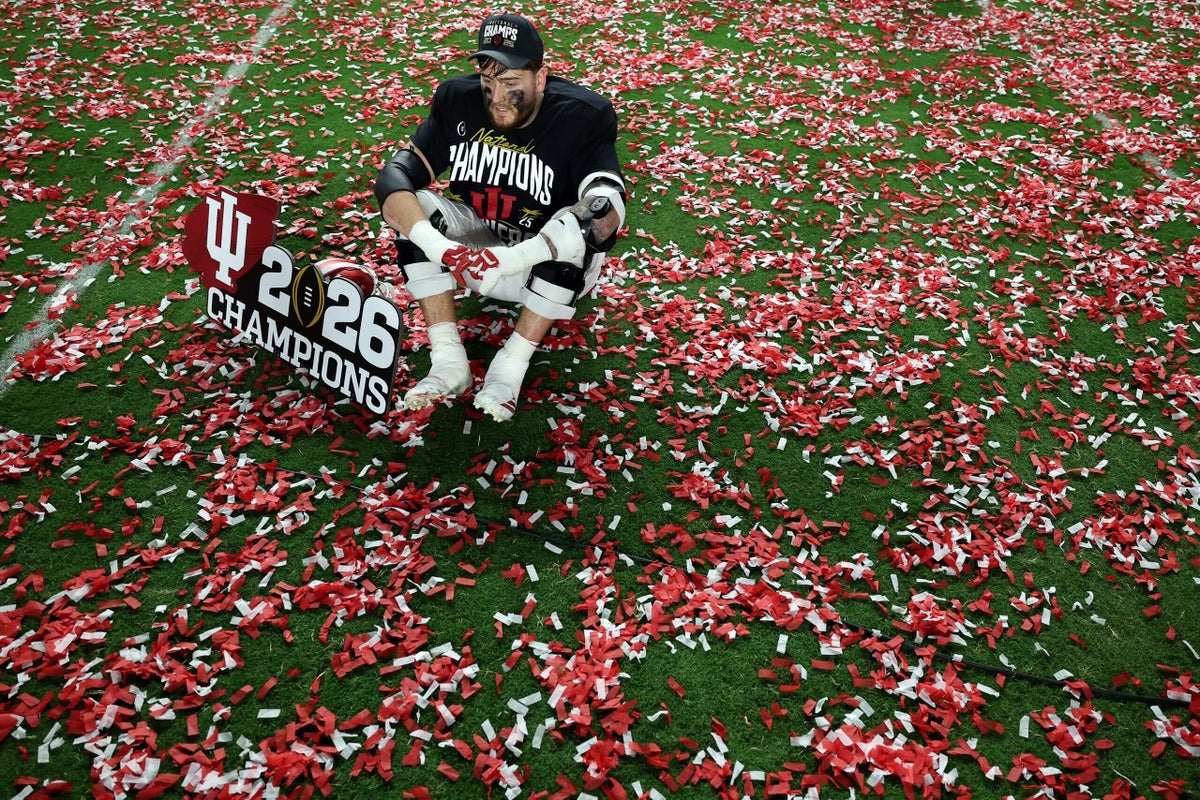
Source
nytimes.com
And now, 16 Final Thoughts from the College Football Playoff National Championship Game, aka the night Indiana officially became our overlord.
1. Six games into Indiana’s eventual 16-0 season, I wrote, “Indiana winning a national championship would be the most remarkable story in the modern history of college football.” While reiterating, regrettably, that I did not think it possible for Indiana to win a national championship.
Well, it happened. And in hindsight, I undersold it. This was the most remarkable story in modern sports history.
2. Imagine if, three years ago, someone showed up at your door and said, “I’m from the future. I know which team will be the first 16-0 national champion since the 1890s. Do you know who it is?” How many different schools do you think you would have guessed before you got to Indiana? At least 40. Maybe 50 or 60.
The idea of Indiana winning a national championship in football in the second year of the 12-team Playoff would have seemed less conceivable than the Washington Wizards winning the NBA Finals. Or Mongolia winning the most medals at the Paris Olympics. (OK, that would be crazier.)
But No. 1 Indiana really did win a national championship Monday, beating No. 10 Miami 27-21 in one of the most dramatic finishes of the BCS/CFP era. And as unimaginable as that would have seemed for most of the past 150 years, the only surprising part in the end was that the Hoosiers very nearly lost.
3. There have been plenty of Cinderellas in other sports — the Miracle on Ice, George Mason going to the men’s NCAA Tournament Final Four in 2006, Leicester City winning the Premier League in 2016. But what makes this rags-to-riches story unprecedented is that these Hoosiers, unlike Hickory High in the movie “Hoosiers,” were the furthest thing from a plucky underdog.
In the span of two years, Curt Cignetti turned the all-time losingest program into an absolute freaking machine. A 16-0 team that outscored its opponents 666-187, including 38-3 (over Alabama) and 56-22 (over Oregon) in its first two Playoff games.
But just like in “Hoosiers” — and every other sports movie ever made — the champs still had to survive their stiffest test in the third act.
4. Shortly before Nick Saban pulled a fast one on ESPN’s pregame show and picked Miami to win (while donning a Miami cap, for some reason), he paid the Hoosiers quite a compliment. The seven-time national champion called Indiana “the most complete team I’ve seen in college football in some time.”
That part proved prophetic, and arguably even more evident than in all those lopsided victories.
5. Indiana was mortal for most of Monday’s game. Its offensive line couldn’t handle Miami’s star pass rushers, Rueben Bain Jr. and Akheem Mesidor. Fernando Mendoza had his lowest passer rating (117.1) since Week 1. Mark Fletcher Jr. became the first opposing running back all season to crack 100 yards on the Hoosiers. And the second-least penalized team in the country committed two costly ones (a false start on All-America left tackle Carter Smith and a roughing the passer on defensive tackle Mario Landino) in the last two minutes.
So the Hoosiers found other ways to make plays.
There was Mikail Kamara’s blocked punt in the third quarter, which Isaiah Jones ran in for a much-needed touchdown at a point in the game when IU’s offense was struggling the most. There was Mendoza’s epic touchdown run on fourth-and-4 at the Miami 12, after Cignetti called a timeout and broke out a QB run play they’d installed for just that situation. And of course, with 48 seconds remaining, Jamari Sharpe’s interception of Carson Beck at Indiana’s 6-yard line sealed the title.
It was Sharpe’s first pick of the season. Because truly, everyone on that team made plays.
6. In some ways, sophomore receiver Charlie Becker is a one-man representation of the Indiana story. He played mostly special teams as a freshman last season and had just seven catches through the first nine games of this season. Becker finally got his shot in November — when starter Elijah Sarratt missed two games — and overnight became a human highlight reel. He was the star of the Big Ten Championship Game, caught a touchdown against both Alabama and Oregon, and, in the fourth quarter on Monday, made two of his patented “stop-short-and-catch-the-ball-in-the-air-while-falling-on-your-back” plays, one to convert a fourth down.
It makes you wonder who else was sitting on Indiana’s bench all season that will turn into next year’s Charlie Becker.
7. Two years ago at this time, Cignetti was still the largely unknown lower-level coach who created about a 12-hour viral moment with his “I win, Google me” quip at his introductory news conference. Even that didn’t get much national attention until much later. And a year ago this time, Mendoza was a good-but-hardly-great quarterback who’d only left an impression on either Cal fans or fans of teams that had played Cal.
Both will now go down as college football legends.
Cignetti defied the modern coaching trajectory in every way. Saban, Dabo Swinney, Kirby Smart, Ryan Day — they all shot to stardom in their 30s or early-to-mid 40s. Cignetti did not get his first power-conference head-coaching job until he was 62, and yet he embraced the sport’s new roster-building model more feverishly than any of them and shot straight to the top of the ladder.
And Mendoza is now a Heisman winner, national champ and, coming soon, likely a No. 1 NFL Draft pick. All while giving the most articulate postgame interviews in the sport.
8. While I’m not usually a fan of viewing college football through the NFL prism, I’m truly curious to see where some of Indiana’s stars get drafted this spring and how their pro careers turn out.
The Hoosiers absolutely deserve to be in the conversation about all-time great teams: They won five games against teams that finished in the committee’s top 10, and seven that will finish in the Associated Press Top 25. But as of now, the perception is they weren’t dripping with high-end talent like a 2001 Miami or 2019 LSU.
That may be so, but I find it hard to believe IU could be this good with Mendoza and a bunch of third- and fourth-rounders. Surely some of those offensive and defensive linemen will go on to become All-Pros. Or linebacker Aiden Fisher becomes a 12-year NFL starter. Or cornerback D’Angelo Ponds leads the league in interceptions in a couple of years.
The 2025 Hoosiers will go down as a great team regardless, but sometimes we gain an even deeper appreciation with time.
9. I certainly have a deeper appreciation already for 2025 Miami. Because I thought the Canes were going to get trounced. Or at the very least, struggle to move the ball. As appeared to be the case in the first half.
10. Fletcher was just as tough and elusive against No. 1 Indiana as he was against Texas A&M, Ohio State and Ole Miss. The O-line didn’t flinch against the best D-line in the country. And stud freshman Malachi Toney did his thing, catching 10 passes for 122 yards, including a 22-yard touchdown. Carson Beck led the Canes on touchdown drives of 81 and 91 yards in the third and fourth quarters.
With 1:42 left, down by 6, the oft-maligned Beck took over at his own 25 with a chance to become an all-time Miami legend. That did not happen. And frankly, you could kind of see it coming.
11. Beck was at his best in the Playoff when Miami was pounding the rock, and he could play off of that. He converted 7-of-9 third-down throws against Ole Miss. But he never stopped making occasional dangerous throws, both in that game, when he got picked once, and in this one, when he nearly got picked twice prior to that final drive.
In a two-minute situation where Fletcher couldn’t be a factor, Miami fans may have been holding their breath every time Beck dropped back. He completed three of his first four attempts, but on the fifth, his pass wasn’t particularly close to intended receiver Keelan Marion, giving Sharpe an easy interception.
It was a cruel ending for a sixth-year senior who finished 37-6 in his three seasons as a starter for Georgia (2023 and ’24) and Miami (’25), was the ACC’s top-rated passer this year and scored the game-winning touchdown run in the semis.
12. My friend, podcast co-host and leading Miami authority Bruce Feldman has long insisted we can’t say “The U is back” until they’re holding a parade in South Florida. But man, Mario Cristobal got the Canes so close to being back.
From all the rappers and Pro Bowlers on the field before the game, to Michael Irvin being so ubiquitous he got his own SNL sketch, the last month has been a trip down memory lane to Miami’s early 2000s heyday. The 2025 team wasn’t the 2001 team by any means, but it reminded folks how fun it can be when “The U” is relevant.
And while most of the big names from this team are moving on, Cristobal should have the Canes back in the mix next season. Especially if they land another star quarterback in the portal. Which, they might have by the time you read this. Because …
13. While the product of college football has never been better — see 2025 Indiana — the enterprise of college football has never been more dysfunctional. And there’s no better illustration of that than the Darian Mensah saga.
On Friday, three days before Indiana-Miami and the last day the portal was open, Duke’s All-ACC quarterback announced his intent to enter the transfer portal. Despite having another season left on his two-year NIL contract at Duke, where he was already making nearly $4 million a year. It’s widely assumed he’s heading to Miami, which previously offered $6.5 million to Alabama’s Ty Simpson to try to get him to pull out of the draft.
It remains to be seen if this becomes another Washington-Demond Williams Jr. story, where Duke threatens legal action to enforce the contract. But it’s already clear that the elaborate post-House settlement NIL model the conferences introduced just six months ago is failing to rein in the “Wild, Wild West.”
14. While I’ve long suspected the College Sports Commission/NIL Go model won’t hold up in court when challenged, I recognize the current environment is unhealthy. So is limitless conference realignment and a Playoff that runs later than the NFL divisional round. And unfortunately, the instability is only going to get worse, not better, in the coming years.
15. But as of now, there’s no evidence any of it is negatively impacting the sport’s popularity. If anything, it’s thriving. And it’s not a coincidence. The Cignetti-Indiana story would not have been possible pre-NIL/transfer portal.
Parity is making the product of college football healthier, basically in spite of the fact that the enterprise of college football is suffering a never-ending flu.
16. With that, thank you for reading Final Thoughts all season long. Let’s do it again in the fall.