NCAA Football
How the Palestra became a shrine for college basketball and Philadelphia hoops
Source
cbsnews.com
Merriam-Webster's dictionary defines the word "shrine" as a place or object hallowed by its associations. In the world of sports, there are only a few special stadiums or ballparks that have earned that most rare distinction.
Wrigley Field in Chicago. Fenway Park in Boston. Lambeau Field in Green Bay, Wisconsin. Sports playgrounds, which have stood the test of time. In Philadelphia, there is the Palestra, known as much for the history it has witnessed as the memories and lives it helped shape.
The doors opened at the Palestra on Jan. 1, 1927. Greek professor Dr. William N. Bates suggested the name because in ancient Greece, athletes would compete in various sports in a rectangular enclosure known as a palestra in front of an audience.
The Palestra, on the campus of the University of Pennsylvania, however, is one of a kind.
"It has to do with the ghosts that are in here. Those ghosts live in, not just the players and the coaches and the games, it's the people that sat in these seats," former St. Joe's head coach Phil Martelli said. "They were from South Philly, or they were from South Jersey, or they came in from Harrisburg, and every person that's ever been in this building can tell you where they sat."
Fran Dunphy coached three of the Big 5 teams — Penn, Temple University and La Salle University — for over 33 years, and Fran McCaffery is in his 30th season coaching and his first back at his alma mater at Penn. In addition to having all coached games at the Palestra, all three also grew up in the Delaware Valley.
"I grew up coming here," Dunphy said. "It was a bunch of guys in the neighborhood. I can remember one of my best buddies. His father took us to a tripleheader NCAA Tournament game."
"It's something that I'm really impressed that it still exists the way it does," McCaffery said. "It's still here. Haven't really done a lot to it, looks the same as it did when I walked in this building 55, 60 years ago."
The Big 5 was created in late 1954, and the Palestra was its home. All Big 5 games were played there, often scheduled as double or triple headers. The competition was fierce.
"The spirit, the rivalry, many of the participants grew up in the Philadelphia area," Dan Baker, former executive secretary of the Big 5, said. "Philadelphia high schools, suburban high schools, Pennsylvania, New Jersey and went on to college at one of the schools. They played each other on the playgrounds."
Baker's résumé is as long as the Schuylkill River, but he's the longest-serving public address announcer in MLB. He's been with the Philadelphia Phillies since 1972. He's called a ton of Big 5 games and was its executive director for 16 years. He also grew up locally.
"When you talk about history, and not just sports history, and you talk about buildings in the city of Philadelphia that are important to people and have meaning for all of us, the Palestra's one of those," Baker said.
That's because the Palestra is so much more than just an athletic venue.
"I can't tell you the number of people over the years that would tell me, 'I had my first date here,' and then, 'I married my wife because of that experience I had at the Palestra,'" Dunphy said. "It's just an amazing dynamic that goes on here. It's just one of those places that's filled with aura."
"This was a place where everybody could come and cheer for their team," Baker said. "It brought people together."
"Now you think back to the '60s and '70s, different times, and that's the great thing about sports, great thing about basketball in particular," McCaffery said. "We were all together for the same purpose. To watch great basketball, to encourage our young people. And you sort of saw the transformation in how communities operate, and that's why, frankly, in those [years] it was fairly segregated. Not in this place."
Basketball stars who played at the Palestra
The more you listen, the more apparent it is that the Palestra isn't just another stadium. It's a shrine.
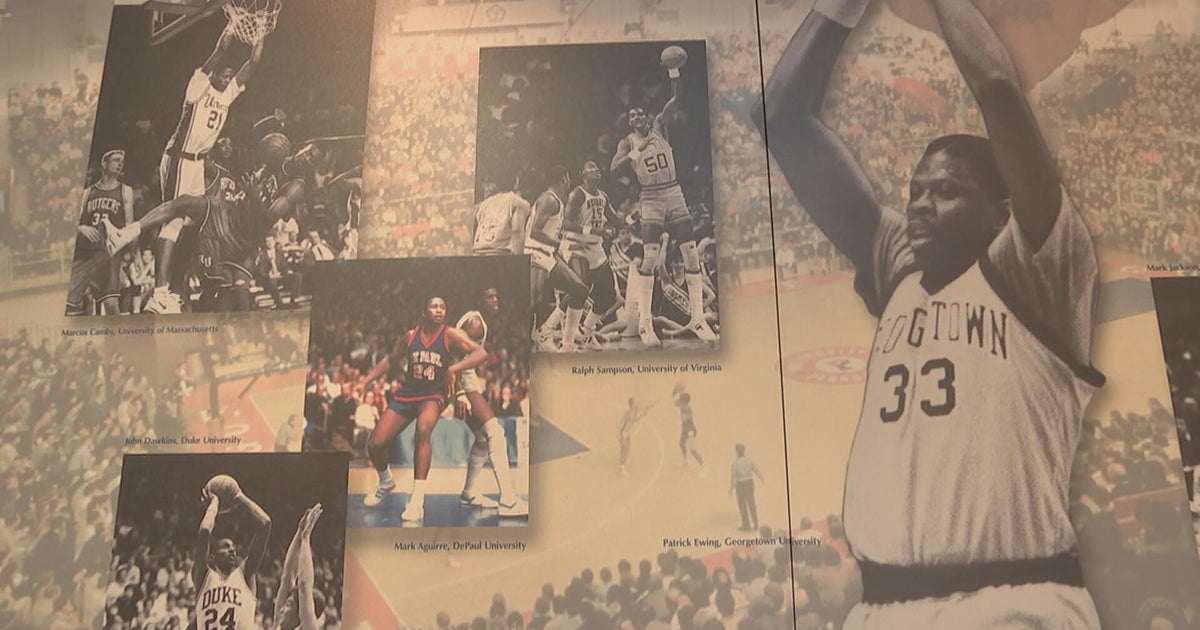
"People marvel when they walk into this building," said McCaffery, who described the corridor at the Palestra as a "museum of basketball," noting that Kobe Bryant once played there in high school.
"The great players who have represented La Salle, Penn, St. Joe's, Temple, Villanova, now Drexel, as part of the Big 5, you and I were looking at a Big 5 yearbook and the great teams and the great stars that played," Baker said. "They used to pick an all-opponent team every year, and you and I were looking at the 1958 all-opponent team.
"Wilt Chamberlain, Kansas; Oscar Robertson, Cincinnati; Jerry West, West Virginia, played on this floor against Big 5 teams."
The corridor at the Palestra is literally a museum of college and Philadelphia basketball, memorializing all the history made here. Even beyond basketball, which includes concerts and more.
"We've had tennis matches here," Mike Mahony, director of athletic communications at Penn, said. "We had the Virginia Slims tournament back in the 1970s in the early days of women's tennis. The Palestra was a mess hall during World War II for three years, so for three years all the games were moved over to Convention Hall, where all the hospitals are now."
It's apparent that mere words don't do this place justice, nor can the story about it. The Palestra is more than the games played here, the legends who coached here and the players who enthralled the crowds. The Palestra is in Philadelphia — it represents the best of the city.
"Whether it would be to come out seeing people cleaning up or the security guards ushering people to the corridors, of all the things, of all the honors and the accolades and the wins and even the losses, if they were to put on my headstone, 'Coached in the Palestra,' that'd be worth it," Martelli said.
The Palestra is known as the "Cathedral of College Basketball." No other arena has hosted more visiting teams, more regular or postseason men's games or more NCAA Tournament games. The Palestra turns 100 on Jan. 1, 2027.