NHL
‘Give it some time:’ Inside Tom Dundon’s NHL success amid Trail Blazer uncertainty
Source
oregonlive.com
RALEIGH, N.C. — So that’s what the towels are for.
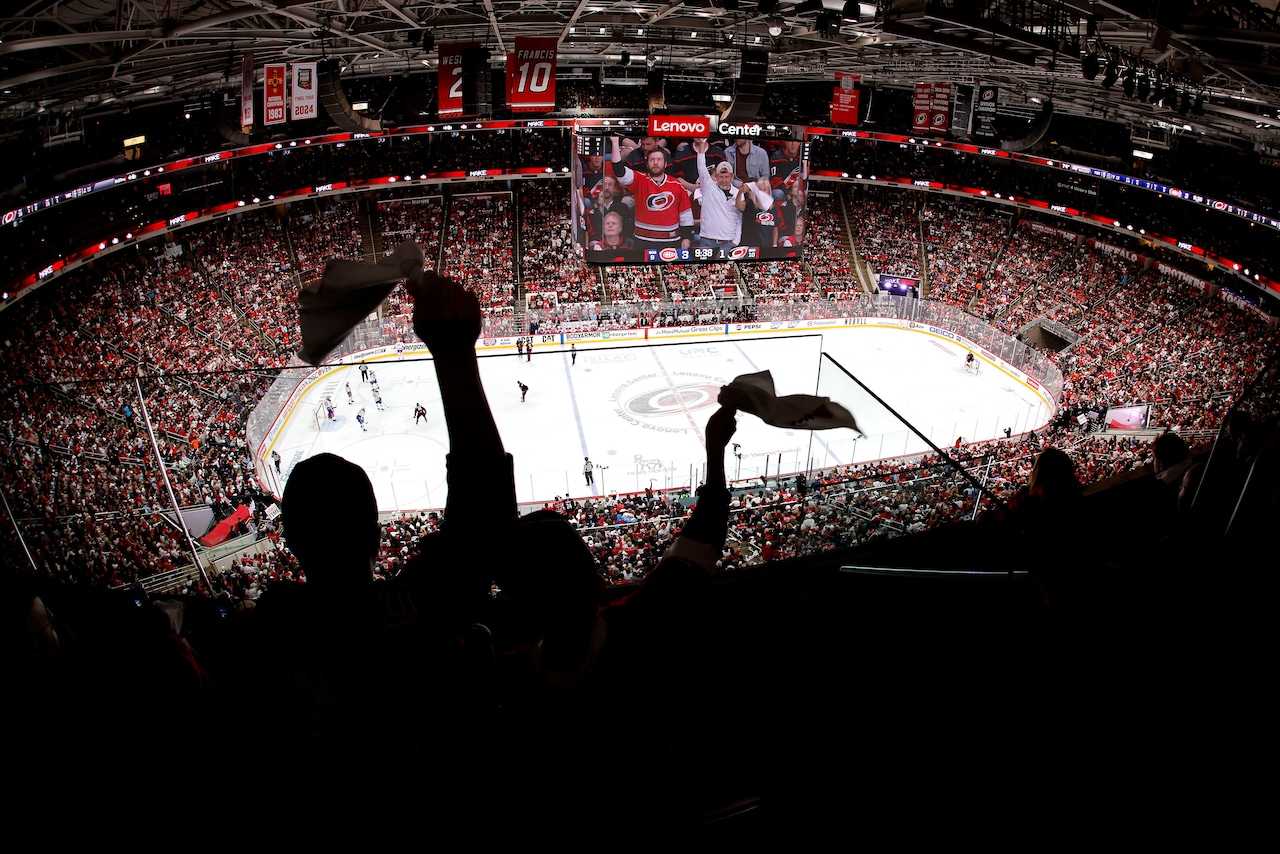
Waved over the heads of the nearly 19,000 hockey lunatics who made up the 163rd straight sellout crowd, the terrycloth souvenirs gave the impression of boiling whitecaps in a raging sea of red and black. A siren screamed. Heavy metal pulsated.
This is a scene that Raleigh’s former mayor, Mary-Ann Baldwin, describes as “a hysteria.”
“It’s not just cheering,” she said.
The delirium blew into the belly of the Lenovo Center from the vast asphalt expanse that surrounds the arena. Hours before Game 1 of the NHL’s Eastern Conference Finals on Thursday, fans of the Carolina Hurricanes partied hard on the sweep of blacktop that is home to the NHL’s biggest nightly tailgate.
They tossed bean bags and Frisbees, and they seared tomahawk steaks. They downed shots of Fireball off hockey sticks and local ale from mugs shaped like ice skates.
At this moment, Raleigh feels a bit like Bizarro Portland. Stumptown in the upside down.
It is another midsize metropolis that boasts just one team in a “big four” sports league. And that one team is owned by Texas billionaire Tom Dundon, the new buyer of the Portland Trail Blazers whose operational cost-cutting and negotiations over an arena renovation have left some Oregonians on edge .
But here, against the backdrop of a fully realized Dundon operation, fans on the street justify the owner’s cost-cutting as smart rather than cheap. Construction crews work behind temporary walls on arena renovations paid for by taxpayers. At the same time, local politicians praise Dundon’s investment in the city.
In Portland, Dundon has been a shock to the system. In Raleigh, he’s been a shock to the heart, reviving a franchise that missed the playoffs for nine years before his arrival.
“He’s playing a major role in how our city moves forward,” Baldwin said.
Dundon has committed to investing $800 million into development around the Lenovo Center as part of the agreement that puts $300 million of public funds toward a building renovation. Fears of relocation — to Houston, perhaps — were allayed after a new 20-year lease was signed in 2023.
The out-of-town owner bought a sports bar across the street from the arena and, perhaps ironically, named it The Local. Brisket mac and cheese costs $19, and employees are instructed to always show pickleball on at least some of the restaurant’s 22 screens. (Dundon is a primary investor in Major League Pickleball and poured $225 million into the league earlier this month.)
“If he bought (the Hurricanes) with a plan to leave,” Hurricanes CEO Brian Fork said, “he could have tried to execute on that. But he did the opposite of that and sort of doubled down in this market.”
The Hurricanes have now reached the postseason for eight consecutive seasons and, for the third time in four seasons, are on the doorstep of the Stanley Cup Final.
“Tom Dundon has definitely not done us dirty,” said 41-year-old Tim Gourlay, sipping from a red plastic cup in the parking lot.
Soon, Gourlay would don a long blonde wig and silk red robe to transform into his game-night alter ego, Caniac Flair, an homage to the North Carolina-born wrestling legend Ric Flair.
Nearby, Randy Sweigart, a season-ticket holder for more than two decades, packed his tailgating gear into the back of a black SUV before heading to his seat in Section 101.
When Dundon made the jump into sports ownership with the purchase of the Hurricanes in 2018, Sweigart, a retired plant manager for the Mt. Olive Pickle Company, told him, “I’m tired of you saving me money on playoff tickets. I want you to start charging me for playoff tickets.”
“He took me at my word,” Sweigart said. “We’ve made the playoffs every damn year.”
Winning, it seems, does cure all.
It is disorienting to hear such praise of Dundon, whose arrival in Portland has brought a squall of its own. His cost-cutting measures have drawn harsh rebukes from across the NBA, including Blazers legend Clyde Drexler, and tense negotiations with the city and Multnomah County make the long-term future of the Moda Center and the team itself far from certain.
Last week, the franchise laid off more than 70 employees, the sharpest and most visceral reminder yet that these are no longer Paul Allen’s Trail Blazers.
It is a dramatically different situation than when Dundon inherited the Hurricanes from software magnate Peter Karmanos.
“When he bought the team here,” Fork said, “it had been under the leadership of an owner that wasn’t putting a ton of money into the team.”
Dundon added staff, invested in the hockey operations department, and bulked up on analytics, although he also made cuts — most notably eliminating the standalone radio broadcast and the Hall of Fame play-by-play announcer Chuck Kaiton.
“He’s not just a slash and burn type of owner or something like a private equity fund that just wants to cut costs and expenses,” Fork said. “He’s going to walk into an investment, make a full assessment of it and say what do we need to do to make this run efficiently for the long-term.”
Fork said the Hurricanes have about 200 employees, which he called lean relative to other NHL franchises.
“We feel like we have the right number of people to do the job here,” he said.
While all professional teams are for-profit businesses, wielding a sharp pencil on budget line items is not exactly in the NBA’s DNA.
The Los Angeles Lakers may have been the league’s last true mom-and-pop shop and were just sold to Mark Walter, the owner of the two-time defending World Series champion Los Angeles Dodgers, whose opening-day baseball payroll was just over $411 million.
How do you square the reality of Dundon’s ownership when people like Walter and former Microsoft CEO Steve Ballmer are pouring cash into their teams the way Hurricanes fans pour cinnamon whiskey?
“He’s going to put the money on the floor,” said Sweigart, the pickle-maker. “He doesn’t care about anything else. He doesn’t want to waste money anywhere else.”
The bare-bones methodology has worked in a bare-knuckle league. But what might have been seen as innovative in the NHL reads as completely deranged in a league as extravagant as the NBA.
In April, former NBA player Chandler Parsons tweeted that Dundon’s approach was “how to never get a free agent.” Podcaster Bill Simmons nicknamed the owner “El Cheapo” and former ESPN analyst Bomani Jones declared that “the league made a mistake” approving Dundon as an owner.
The Dundon Method has gone global. It might also be weeks away from delivering Raleigh the Stanley Cup.
Such is the chasm between Dundon’s first team and his new one. The NBA’s newest owner, who built his fortune on high-interest auto lending, is applying what feels like a one-size-fits-all approach to his latest endeavor, right down to the widely panned decision to forgo T-shirts for fans at the Blazers’ first playoff games in four years.
Instead, fans arriving at the Moda Center for Games 1 and 2 found rally towels and seemed unsure what to do with them.
“I wasn’t trying to save money,” Dundon said last week on the “Game Over” podcast with Max Kellerman and Rich Paul. “I just kind of thought T-shirts were kind of silly. … In Carolina, we do towels and it’s awesome.”
It is, in fact, awesome.
The essential question is whether what has worked for Dundon in Carolina can translate to his latest investment. If Dundon’s fundamental miscalculation on towels represented growing pains or revealed an owner who is, literally or figuratively or both, out of his league.
Fork, who worked as a lawyer in private practice when Dundon arrived in town, is from Raleigh and had been a Hurricanes fan long before he started working for them. He took his company’s tickets to games when no one else wanted them, in days when fans would be invited to come down from the 300 level to fill in the lower seats.
He’s watched as Raleigh, a city where fan allegiances are split among four prominent universities, has found a unifying force in the Hurricanes.
“I just think we’re lucky the Hurricanes were for sale when he wanted to buy a team,” Fork said.
His message to Portlanders, with the caveat that Dundon signs his paycheck, is this: “Just give it some time. This is going to turn around. You guys got really lucky that this guy bought your team. He has a relentless desire to succeed.”
Again, bizarro world. Even the Hurricanes’ logo, the swirling red and black eye of an Atlantic storm, looks as though someone smeared the Trail Blazers’ iconic pinwheel like finger paint.
The Blazers remain locked in tense, tumultuous negotiations with the Portland City Council and county leaders over the $600 million Moda Center renovation that was blessed by the Oregon Legislature earlier this year.
It’s a debate that has echoes of the agreement Dundon hammered out with Raleigh in 2023, when the absence of a deal could have forced relocation.
Those were the stakes then, and 3,000 miles west of Raleigh they are the stakes now.
“No one needed to tell me,” said Philip Isley, who negotiated the deal on behalf of the Centennial Authority, which operates Lenovo Center. “I knew full on.”
Said Baldwin, “There was never a threat, but I’m not naïve.”
It’s a fear that is in Raleigh’s rearview. Earlier this spring, Lenovo Center’s View Bar opened on the 300 level. It is a standing-room destination offering a bird’s-eye view of the arena.
Next to the rink on the ground level, there are seven posh suites that offer easy access to premium seats. Plans call for building out the building’s façade and replacing the ticket offices with a large beer hall.
If Moda Center is tired, as is often said, then old parts of its Raleigh counterpart are downright narcoleptic.
“We’re being very innovative and figuring out how to stretch the dollar,” said Ellen Page, the Hurricanes’ vice president of business development. “Most arenas are over a billion dollars. … These are old buildings that need a lot of love.”
She added: “You’re given a budget and you figure it out.”
Over the next 15 years, Dundon will start developing the area around Lenovo Center — which includes Carter-Bryant Stadium, the home of NC State Wolf Pack football — into a multi-use district that will include dining, housing and retail.
It sounds wonderful. Canes fans still have questions.
“What we’re concerned about now is all the upgrades that they’re doing,” Sweigart said, “and afraid they’re going to build everything out here and take away the tailgating.
Pressed for any other concerns about ownership, Sweigart nodded toward a sign that read, “$75.”
Speaking of champagne, if his Hurricanes do bring home the Stanley Cup and they make a mess of the locker room spraying bubbly, there will at least be no shortage of towels on hand.