NCAA Football
College basketball mailbag: Where can the top 10 teams improve? Is Miami (Ohio) at-large worthy?
Source
nytimes.com
College football is finally over, which means, blessedly, that it is finally time for everyone to turn their attention to college basketball. Before you know it, the single best sporting event on the planet, the NCAA Tournament, will be here. Feel free to start your countdown to Selection Sunday (March 15) right now.
It’s possible you’re playing catch-up midway through the college hoops season, and we at The Athletic are here to help. Given that Indiana (Indiana!) just won a national championship in college football, it seems like anything could happen in college sports right now … and maybe that will extend to our favorite sport, too. By the way, has anyone checked in on, like, the entire Purdue fanbase?
We are about 10 weeks away from March Madness. What does each team in the AP Top 10 need to show to gain your support as national title picks? What are the realistic chances of a team outside of the top 10 winning the title? — G.S.
I’ll start with the latter question. A few teams outside the top-10 — BYU, Florida, Vanderbilt, maybe Illinois — could realistically make the Final Four, at which point anything’s possible. (Of those four, though, BYU was the only one in the top 12 of the Week 6 AP poll, which has been a championship cheat code since 2004.) As for the thing every top-10 team needs to show to inspire (more) confidence they can win it all:
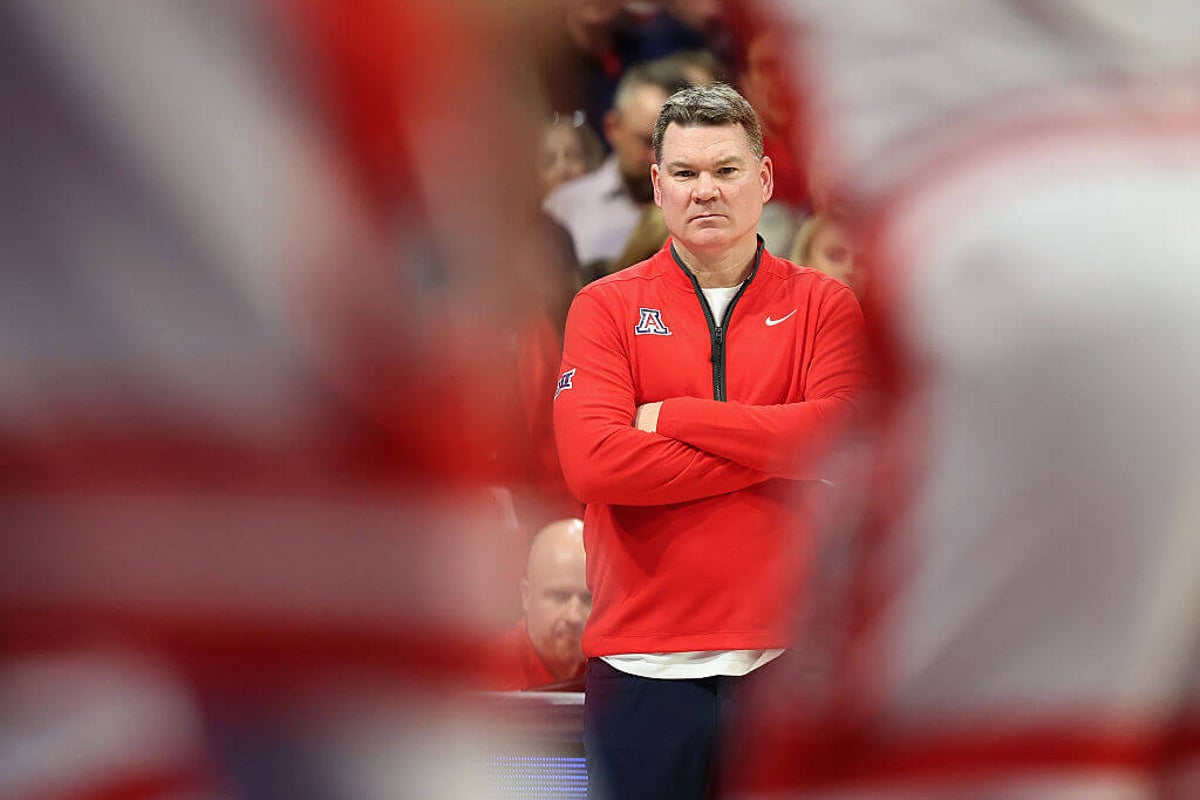
No. 1 Arizona: Uh … Bueller? The Wildcats are one of just four teams with a top-10 adjusted offensive and defensive efficiency ranking — alongside Michigan, Duke and Gonzaga — and only seem to be getting better. But it would be nice to see Zona play another top-15 caliber team; it’s been over a month since Tommy Lloyd’s team beat the brakes off Alabama. That’ll change when it goes to BYU on Monday.
No. 2 UConn: Better offensive flow and shotmaking. The Huskies only make 34.7 percent of their 3s — barely a top-150 rate nationally — and have turned the ball over on 18 percent of their possessions since Christmas, which ranks 360th nationally. But the defense is as stout as it has ever been under Dan Hurley.
No. 3 Michigan: A return to the Wolverines’ early-season 3-point shooting. Until Tuesday’s win over Indiana, Michigan hadn’t made double-digit 3s in a game since before Christmas, only making 28.5 percent of its triples during over a six-game stretch.
No. 4 Purdue: Better interior defense, to prevent last season’s biggest shortcoming from re-emerging. Purdue is allowing opponents to shoot 60.8 percent on 2-pointers since Christmas. Six straight teams have made more than 50 percent of their 2s against the Boilermakers, after that only happened five times in the team’s first 13 games.
No. 5 Duke: Continued effectiveness from Isaiah Evans, who has finally settled into his anticipated role as Duke’s No. 2 scorer next to Cam Boozer. In ACC play, Evans is averaging 20.2 points per game while making 38.8 percent of his 3s, preventing the Blue Devils’ offense from stagnating like it did at times the first month and a half.
No. 6 Houston: Expanding — or at least not shortening — the rotation. The Coogs’ starting five all average at least 23.4 minutes per game, with reserves like Isiah Harwell and Ramon Walker still seeing inconsistent time behind them. Kelvin Sampson’s starters are as good as any in the country, but Houston’s going to need depth at some point.
No. 7 Nebraska: Win an NCAA Tournament game. It’s simple, but when you’re the only high-major program to have never won a game in March Madness, that seems like a fair starting point before we start talking about four (or five, or six) straight wins.
No. 8 Gonzaga: Get healthy in the frontcourt. Starter Braden Huff is out four to eight weeks with a knee injury, while Graham Ike missed the Seattle game with ankle soreness. Considering Gonzaga leads the nation in points in the paint (48.2 per game), getting those two right is imperative.
No. 9 Iowa State: Get back to turning teams over. In consecutive losses to Kansas and Cincinnati last week, the Cyclones posted their two lowest defensive turnover rates of the season, a devastating turn for a team that’s fifth in the country in points off turnovers.
No. 10 Michigan State: Stop turning the ball over. Jeremy Fears Jr. remains one of the nation’s best point guards, but Sparty is turning it over on almost one in every five possessions since Christmas. That’s an unsustainable rate. — Brendan Marks
Based on recent decisions, it seems possible, if not probable, that a kid could declare early for the NBA Draft, not like where he was picked, and sue/threaten to sue to get back any remaining eligibility. Is this something that the NCAA would allow, or would they essentially be forced to rule against players in this scenario because it would risk their relationship with the NBA? I’d assume the same question could be asked regarding the NFL and college football. — Dan K.
This question is timely — on Tuesday, former Alabama player Charles Bediako sued the NCAA in hopes of being able to return to the Crimson Tide, nearly three years after he left for the NBA Draft. Bediako never played in the NBA, and was not drafted, but signed two-way contracts to appear in the G League, and the NCAA put out a strongly worded statement in response.
“The NCAA has not and will not grant eligibility to any prospective or returning student-athletes who have signed an NBA contract,” it said.
As I wrote in the aftermath of Baylor’s James Nnaji first being deemed eligible, the situation you’re describing — where a player declares early, either goes undrafted or later than he hoped, then attempts to return to school instead — is exactly what multiple college basketball stakeholders have predicted as the next frontier of eligibility. Now, that’s going to be a relatively small group of players, but if you’re good enough to potentially go pro, you’re good enough to move the needle for a competitive college team.
Where the NBA factors in is a key component to your hypothetical: What happens to a player’s draft rights if he does return to school? Does the team that drafted the player retain those rights for the future? If so, then the value of second-round picks could skyrocket; you’d effectively have a new “draft-and-stash” model, just domestically instead of internationally. And if a team does retain those rights, for how long? Another season? Two? Indefinitely? Not at all? The NBA hasn’t weighed in yet, but that probably has to come sooner than later, before a team takes the plunge on someone who might try to sue his way back into college hoops. — Marks
The NCAA has released a new tournament called March Sadness. The bottom-eight Power-4 teams will face off in a tournament where the losers advance. Who’s going (assuming no one can drop out), and how can they keep themselves from going next year? — James S.
As of Tuesday morning, in order of worst to best net rating, that would be:
There are mostly two types of coaches on this list. First, you have the newbies: Alex Jensen at Utah, Buzz Williams at Maryland and Luke Loucks at Florida State. All are in their first seasons at their respective schools. You’d imagine that over time, especially Jensen and Loucks with their NBA experience, those guys pick up recruiting and are able to land better talent. Then you have your search season candidates, who have to prove over the next month and a half that they deserve to keep their jobs: Rutgers’ Steve Pikiell, Boston College’s Earl Grant and Georgia Tech’s Damon Stoudamire. (Pikiell is probably the safest of the three.)
Penn State coach Mike Rhoades is in his third season at a program that had one tournament appearance in the 12 years before his arrival. And then there’s Marquette’s Shaka Smart, whose no-portal philosophy has flopped in a major way. Considering the Golden Eagles have made the NCAA Tournament each of Smart’s first four seasons with the program, he doesn’t seem at risk of losing his job, but it’s hard to imagine he won’t be using the transfer portal at least to some extent come this spring. It’s easy not to take transfers when you have the likes of Tyler Kolek and Oso Ighodaro and Kam Jones, but eventually those guys cycle out.
As for how the aforementioned teams can avoid making March Sadness next season? No easy answer for anyone but Maryland and Marquette. The other six are simply among the toughest high-major jobs in the country right now, regardless of who’s at the helm. — Marks
Do you think Marquette’s Shaka Smart is going to have to abandon his no-portal philosophy after this year? There are signs of hope as the season progresses (admittedly dim) but do you see this as unsustainable in the current climate of college basketball? — Brigid S.
This is something I’ve been thinking about a lot this season. I thought Marquette’s strategy was especially interesting because the most notable coach in college football who’s turned his nose up at the portal, Clemson’s Dabo Sweeney, has been roundly — and in my opinion, fairly — roasted for it. But in hoops, there was a general feeling of “Good for Shaka for developing guys and wanting program lifers. What a leader!”
Football, of course, is a different beast, purely because of roster numbers. You can’t lose a lot of production to the portal and not replenish via the portal. And while it’s true a lot wasn’t expected of Marquette this year — the Eagles were predicted to finish fifth in the Big East preseason poll — sitting in ninth place at 2-7 isn’t going to fly for long. Being No. 123 in KenPom isn’t encouraging either.
So yeah, I think Smart is going to have to adapt. That doesn’t mean he has to change his entire philosophy, though. Michigan State is a good example of a program that mostly wants to develop its own players — and recruits players willing to stick around through adversity — but will selectively add from the portal. Four of the Spartans’ starters played for Michigan State last year: Jaxon Kohler, Jeremy Fears, Jr., Coen Carr and Carson Cooper; the other, Divine Ugochukwu, is a transfer from Miami. Surely Smart and Marquette can find a similar happy medium. — Lindsay Schnell
Do either of you have any influence over CJ Moore and his continued ignoring mid-majors in his top 25, especially undefeated Miami (Ohio)? — Hchoops
Let’s say Miami gets through the MAC season undefeated and loses to Akron in the MAC championship. Is this the magical year where the MAC becomes a multibid conference? Seems very unfair to leave out what would be a 30-win Miami team at that point. — Milin R.
I’m with you, why does CJ hate fun so much? I’m kidding, I’m kidding. (And to CJ’s credit, he has Saint Louis ranked higher in his poll — No. 21 — than its No. 24 ranking in the AP poll.)
I’ve been banging the drum for weeks for Miami to get some AP Top 25 love, but I’m going to defend CJ here because lemme tell you, few people in the country know more about or watch more college basketball than that man. Seriously. If you ever find yourself in a game of “Who Wants to be a Millionaire? College Hoops Edition,” make CJ your phone-a-friend and enjoy cashing those checks.
It’s true Miami is an impressive 20-0. It’s also true that their underlying numbers are not, shall we say, otherworldly. The Redhawks are No. 90 in KenPom (yikes) and No. 352 in strength of schedule (double yikes). Their schedule is clearly influencing voters. That’s also going to resonate with the selection committee, which means that no, the MAC is probably not a two-bid league. The sad truth is that in the NIL era, where decent mid-major players are going to jump to the Power 4 whenever possible and the clock might have finally hit midnight for Cinderella, it’s going to be harder and harder for mid-majors to capture the attention of America.
Every voter has their own philosophy about why they rank or don’t rank someone (or vote or don’t vote someone for All-America, conference player of the year, etc). Personally, when I was a voter, I liked to give some attention and kudos to the little guys, especially if they were in the West, because often, I was one of the only voters awake to watch them. I am also of the belief that it is really, really, really hard to win when everyone is gunning for you, and therefore, being undefeated is worthy of a top-25 nod.
But not everyone agreed with me, and that’s OK, because the AP poll is not a math equation, and there are no “right” answers. — Schnell