NHL
Vancouver Canucks rebuild timelines and the next core: Mailbag, part 2
Source
nytimes.com
In part 2 of our post-trade deadline Vancouver Canucks mailbag, we tackle a selection of VIP questions, most of them focused on the future of this rebuilding hockey team.
What’s a reasonable and realistic timeline for a successful rebuild? Who might be part of the core of the next great Canucks team that already plays in Vancouver? Which year would be better to have the first-overall selection, 2026 or 2027?
Hundreds of VIPs submitted questions to this mailbag, and we thank you deeply for your support and engagement. Here’s part 2 of your Canucks mailbag.
Note: Submitted questions may be edited for clarity and style.
When can I expect to enjoy watching Canucks games again? — Cameron M.
It depends on where you set the bar for “enjoyment.”
Depending on the outcome of the NHL Draft Lottery, for example, the Canucks could have a very exciting young, potential superstar players on their roster as soon as next season. Even then, the Canucks probably won’t be ready to contend or even compete credibly for a playoff spot, but if that player is special right out of the gate, then you’ll probably be excited to watch them play as soon as the first game of next season.
If the Canucks are disciplined and clever about rebuilding from here on out, and if they get a bounce or two at the draft lottery, they should emerge with a plucky young team in time for the 2028-29 season at the very least.
With Nikita Tolopilo becoming eligible for waivers, how do you see the goalie situation playing out at the start of the next season? Will the sad Artūrs Šilovs situation be duplicated? — Gastownjeff
I’ll try to get a better sense of how the team views it on the other side of the regular season, but it’s clear to me that Nikita Tolopilo has been Vancouver’s best goaltender this season and that the Canucks can’t risk losing him for nothing on waivers next fall.
The team’s best course of action, given that both Thatcher Demko and Kevin Lankinen have full no-move clauses and limited exchange value in any event, might be to copy the Seattle Kraken, Buffalo Sabres model and roll with three goaltenders next year. Not only would this permit Vancouver to keep Tolopilo, but it would have the added benefit of permitting Demko, who the club should obviously keep on a strict pitch count next season, to have true days off, even on game days when he’s serving as the backup.
You’ve been critical in the past about Filip Hronek’s availability to the media and his engagement when he does interviews. How surprising is it to you that he’s been publicly tagged as an irreplaceable leader and new culture setter in this new era? — Matt M.
I would say that I’ve only really been critical of Filip Hronek’s media presence in the context of any discussion about naming him the captain of a rebuilding team in a madcap hockey market like Vancouver.
Over the next few seasons, in all likelihood, the captain of the Canucks — should they decide to name one — is going to have to wear a lot of losses publicly.
The captain of the Canucks is going to have to stay positive with the media and sell the learning process to fans.
The captain of the Canucks is going to have to be comfortable talking about themselves, and accepting the media narratives that will inevitably accrue to an overmatched side in a market that’s grown understandably impatient after a decade and a half of mismanagement and underinvestment.
I’m not at all convinced that person is Hronek.
That said, he’s clearly been putting in more effort on the public-facing portion of his job, and that’s a welcome development. I’m not at all surprised that he’s touted as a significant leader and culture setter behind the scenes. I just think the captaincy in Vancouver is a significant public-facing responsibility, and one that requires a fairly sophisticated ability to tactfully stickhandle a variety of topics — from team performance to local politics to roster moves — with the media.
Until the past couple of months, Hronek had never seemed to take the time to develop those skills. That’s the sole reason that he’d be a poor choice to wear the “C” in Vancouver.
When all the dust settles, which players from the Horvat/Hughes era end up in the Ring of Honour (or higher)? — Mike B.
I know feelings are still raw at the moment, but I think Quinn Hughes will ultimately end up in the Ring of Honour. At the very least.
In the event that he goes into the Hockey Hall of Fame in 20 years or so, I’ll probably think that he should have his number retired. The first ballot Hall of Fame defender who won the Norris Trophy in Vancouver, to me, should be an open-and-shut jersey retirement case.
J.T. Miller has fewer points and played fewer games for the franchise than Todd Bertuzzi, and Bertuzzi’s number isn’t retired, nor is he in the Ring of Honour. That’s relatively straightforward.
Bo Horvat played fewer Canucks games than Ryan Kesler, who isn’t in the Ring of Honour, and though Horvat narrowly outscored Kesler in Canucks colours, he never won a major NHL award the way Kesler did. I think Horvat misses out.
So, of the three major figures of the last era of Canucks hockey who’ve already departed the organization, I think Hughes is an easy “yes,” and Horvat and Miller are both an easy “no.”
The more interesting cases are the ones that are still active. Elias Pettersson, for example, is seventh in career points produced among Canucks players.
Even if Pettersson never recovers his offensive game, he’s signed for six more seasons after this year. If he isn’t moved, stays relatively healthy and produces 55 points per season, by 2028, he’s going to be in the top-10 among Canucks skaters in games played and will be closing in on passing Stan Smyl as one of the five most productive Canucks players of all-time, too. Throw in his Calder Trophy season, and that’s an unassailable case for the Ring of Honour.
Even just from the vantage point of today, every other Canucks player that’s produced more than Pettersson either has their jersey retired or is in the Ring of Honour. And so is the player that’s right behind him for eighth all-time in points among Canucks players, which is Pavel Bure.
Objectively speaking, Pettersson has probably already amassed the sort of Canucks resume that’s Ring of Honour worthy.
Then there’s Brock Boeser. Boeser ranks 15th all-time in Canucks games played, and will pass Thomas Gradin and Horvat and end this season 13th if he stays relatively healthy down the stretch. If he then plays most of the games in the 2026-27 campaign, Boeser will become the 10th Canucks player to play 700 games for the franchise.
Boeser is also eighth all-time among Canucks goal scorers, and is 35 goals from passing Bure for fifth on the franchise goal scoring leaderboard. He’s also 10th in points, and should pass both Tony Tanti and Bure among all-time Canucks point producers next season.
Depending on how Boeser’s Canucks tenure plays out, he could end up rewriting the franchise’s record books significantly, and that would give him a very strong Ring of Honour case, too.
If the hockey gods would grace the Canucks with one first-overall pick, would you rather it be 2026 or 2027? — John W.
You’d rather pick first overall in 2027, and it’s not particularly close.
That said, I’m very high on both Gavin McKenna and Ivar Stenberg. I see both players as legitimate first-overall calibre prospects most years.
Even if there isn’t a generational centre at the apex of most teams’ lists, I really don’t buy that this is a down year to have the first pick.
McKenna was a historic point producer in the CHL at 15 and 16 and represented Canada at the World Junior tournament in both his draft-minus-one and draft year campaigns. He produced at the second-best points per game rate among all NCAA skaters in his draft year, a roughly comparable production record to what future superstars like Jack Eichel and Macklin Celebrini accomplished in their draft years at the NCAA level.
Now, when we consider that McKenna went to a less stacked college team than Eichel and Celebrini did, and that NCAA competition has levelled up significantly with the advent of the Name, Image and Likeness (NIL) system permitting the top CHL players to join NCAA programs, McKenna’s statistical profile as a prospect is downright exceptional.
As for Stenberg, he played a major role on a stacked Frölunda HC team and was wildly, almost historically productive. He went a bit cold down the stretch, so his SHL season didn’t end up being quite as historic as it looked like it was going to be about a month ago, but Stenberg still finished his SHL regular season as the fifth most productive 18-year-old in SHL history behind only the Sedin twins, Markus Naslund and Tomas Sandstrom. He’s clearly the best draft-eligible SHL player since William Nylander.
Most years, Stenberg would be a credible No. 1 calibre prospect, but based solely on a statistical analysis of the matter, I don’t really see the profile case for preferring Stenberg to McKenna at this juncture.
Neither McKenna nor Stenberg, however, is Landon DuPont.
The term “generational” gets thrown around a lot in discussing prospects in professional sports, but when we’re talking about what DuPont has accomplished as a 16-year-old in the CHL this season, it’s a label that is just true. He’s the best and most productive 16-year-old CHL defender since Scott Niedermayer in 1989-90.
Now, what a player is at 16, 17 or 18 isn’t fate. It’s very possible that McKenna or Stenberg end up having better NHL careers than DuPont.
DuPont, however, looks like a legitimate Connor Bedard-calibre prospect at this point, and as a right-handed defender and plus skater with real NHL size (already), he plays a premium position with almost no holes that you can credibly poke into his overall profile.
McKenna and Stenberg are exceptional. DuPont is something even beyond that.
There’s a lot of focus on who the Canucks can draft with their top pick this year. But who do you have your eyes on with their pick from Minnesota and the early second-round pick? — Mel F.
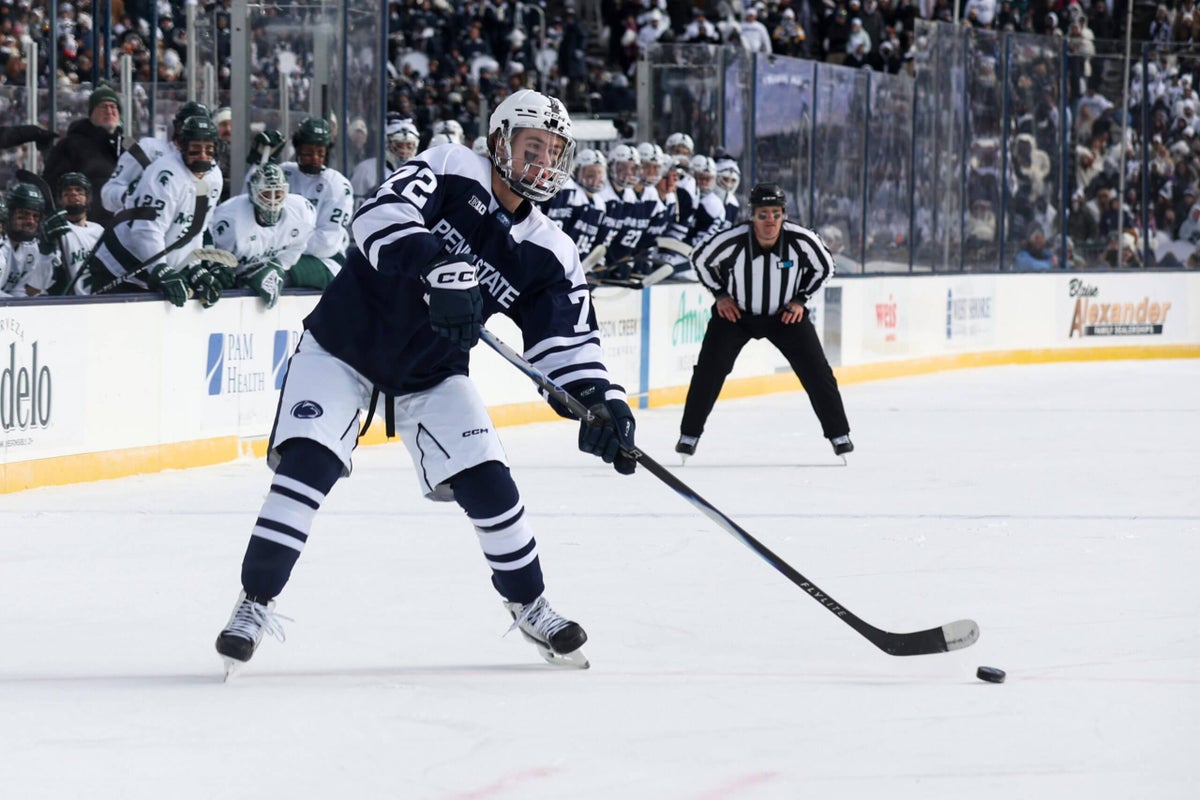
Like everyone else, I’ve spent a lot of time on the top of the draft class, including streaming SHL and Penn State games over the past few months, but I’ve yet to approach the bottom of the first round with the same level of diligence.
I have some scattered thoughts on WHL guys I’ve managed to see play live a few times this season, players like Ryan Lin, JP Hurlbert and Liam Ruck, all of whom I like a lot late in the first round (especially Hurlbert). Generally, though, I have more homework to do.
At a glance, just based on statistical profiles that pop, some of the players that I’ll be most intently focused on when I get down to that work in the months ahead are Swedish centre Alexander Command, a pair of skilled Russian pivots in Egor Shilov and Lavr Gashilov and 6-foot-6 Oshawa Generals centre Brooks Rogowski.
If the rebuild goes as well as you might dare dream, which current players (Vancouver or Abbotsford) are going to be core members of the next great Canucks team? — Paul N.
I think it’s reasonable to hope that the core of the next great Canucks team will feature Zeev Buium and perhaps Tom Willander after they’ve made themselves into top-four calibre defenders in their mid-20s.
Perhaps Liam Öhgren can pop and become a second-line calibre power forward that can complement skilled guys at the top of the lineup.
Maybe, if the Canucks can execute this rebuild just about perfectly, Filip Hronek can be like 33-year-old Alex Edler was in that 2019-20 season before everything in the Pettersson-Hughes era went sideways, and still be a veteran handling tough minutes in a top-four role.
That said, as the club would’ve been better off monetizing Edler for premium assets long before that 2019-20 season, the Canucks would probably do well to consider that lesson in moving forward with Hronek.