NHL
How ‘WAG’ jackets won the NHL playoffs: Brackets, cowboy fringe and a dominant McDavid
Source
nytimes.com
Eight minutes after the surging Philadelphia Flyers clinched a late-season playoff berth with a shootout win over the Carolina Hurricanes in mid-April, standout defenseman Travis Sanheim was on his phone, texting a top-of-mind message to his wife, Alex.
We’re in! Let’s go! Buy the jackets lol
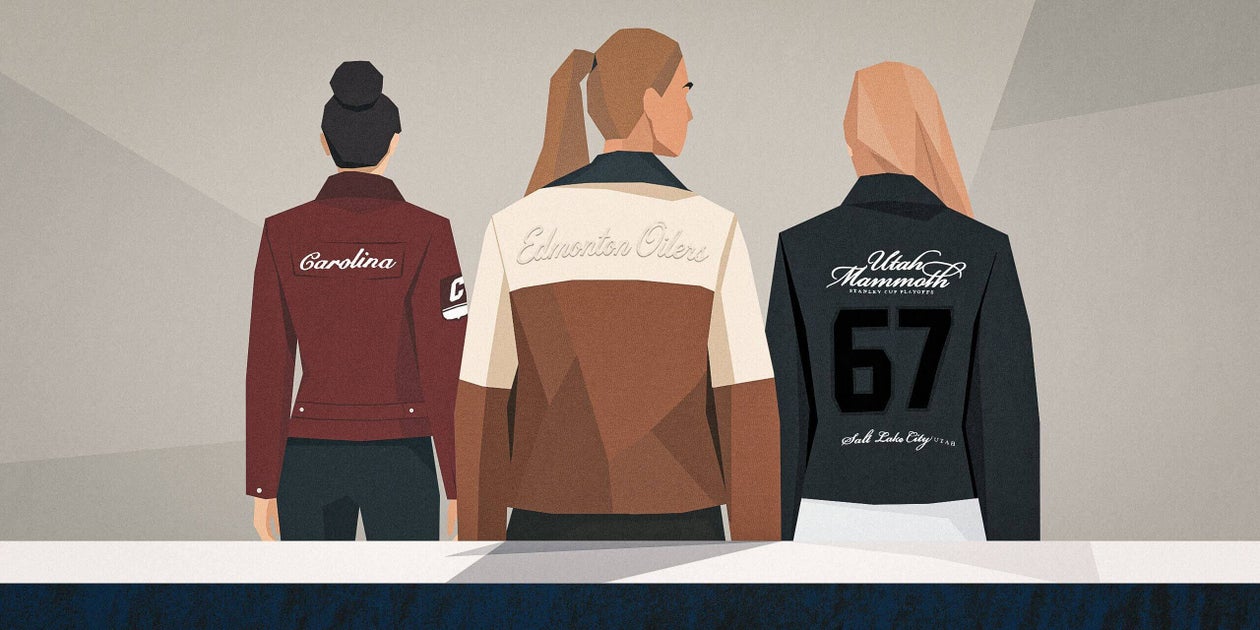
Every game during the Stanley Cup playoffs, wives and girlfriends of NHL players on the home team suit up in their own version of uniforms. Emblazoned with logos, jersey numbers and other custom-designed flair, these jackets have become flashy, fashionable staples of postseason hockey. This year, versions were worn by partners on all 16 teams in the field, with some commissioning extra clothing items such as windbreakers and jeans. Materials ranged from suede to wool to leather, but all held the goal of showing shared support — and standing out.
The 2017 Washington Capitals were among the first teams, if not the first, with partners sporting jackets for the annual postseason tournament. That year, under the leadership of Lauren Oshie, whose husband, T.J., then played winger for the team, they wore matching denim affixed with patches of their respective partners’ numbers and names. Nearly a decade later, the trend is booming in just about every way: from exposure to extravagance to price. In a sense, it has become the NHL’s biggest fashion showcase.
“Every year it’s just gotten bigger and bigger and bigger,” says Gina Gostisbehere, who organized this year’s Hurricanes jackets after it became clear her husband, Shayne, and his teammates were bound for the playoffs.
“In the last year alone they have become a phenomenon,” says Claire Crouse, whose husband, Lawson, plays on the Mammoth.
There’s no spoken competition among partners on different teams; Gostisbehere and Crouse remain friends from their husbands’ time together on the Arizona Coyotes and hyped each other up through this year’s production process. But no one wants to be left behind, either. “I definitely wanted to make sure ours was up to scale, not just a homemade, DIY jacket,” Crouse says.
Danielle Spurgeon, whose husband, Jared, captains the Minnesota Wild, estimates that the league-average playoff jacket costs around $500, a pricey commitment with its utility largely limited to one year. Spurgeon knows some teams’ jackets have neared $1,000, a drastic change from the not-too-distant past: She remembers wearing long-sleeved T-shirts for the 2014 playoffs that sold for about $50 each.
So when Flyers goalie Dan Vladař made the final shootout stop against the Hurricanes to send his team to the playoffs, Alex Sanheim knew she needed to get to work. After celebrating at the arena with fellow wives and girlfriends, she huddled with a few of them to mock up ideas.
As the regular season wound down, Sanheim had kept her eye on a black leather jacket. But she didn’t want to jinx the Flyers by ordering ahead of time. When the team clinched, she began purchasing the jackets almost immediately. They arrived within a week, after which Sanheim brought them to RushOrderTees, a Philadelphia business equipped for embroidery. The custom additions — Flyers branding on the front, right arm and back, as well as individual players’ names on the back and initials on the left arm — were finished in time for Philadelphia’s first home playoff game against the Penguins.
Crouse, meanwhile, felt comfortable enough about Utah’s playoff chances to start planning in February. She and Victoria Stark, a senior designer for the Mammoth, embarked on the project together, using Salt Lake City businesses for production as a nod of appreciation for the local community’s embrace of the team after it relocated from Arizona in 2024.
One night leading up to Utah’s first-ever home playoff game, Crouse and the other Mammoth wives and girlfriends gathered for dinner in Park City, a mountain town southeast of Salt Lake City. They shared a private room at a Japanese grill inside a five-star hotel, where Crouse led a toast: to the playoffs, to the history the Mammoth were making and to “how much heavy lifting these women do behind the scenes.”
Then, to the room’s delight, Stark wheeled in a luggage cart with their black playoff jackets for everyone to wear for the first time.
Eleven years ago, when the NHL’s now-most dominant player entered the league, its now-most dominant playoff jacket designer saw postseason attire as having a “piecemeal vibe.” But as her husband, Connor, went on to make history for the Edmonton Oilers, so too did Lauren Kyle McDavid change the world of hockey fashion.
This year, Kyle McDavid’s high-end sportswear company, Sports Club Atelier, designed jackets for seven of the NHL’s 16 playoff teams, including all of the ones still alive. She also prepared a sample for the wives and girlfriends of Detroit Red Wings players, before they missed the playoffs with a late-season collapse.
The creative process involves Shay Santos, the company’s head designer, talking through ideas with Kyle McDavid and creating mock-ups based on each customer’s vision. Gostisbehere sent in a mood board of different styles, textures and embroidery options she liked. Sports Club Atelier included fun details in some 2025-26 postseason products: The Dallas Stars’ jackets featured cowboy-inspired fringe on the backs, and the belt loops on the Hurricanes’ burgundy jackets are shaped like the team’s logo of a tropical storm warning flag.
The opportunity to work on playoff jackets for players’ wives and girlfriends — commonly abbreviated as “WAGs” in the wider sports world, though the term has been criticized by some as demeaning — can be a huge break for designers without direct locker room connections. Jordi Lutsky was vacationing in Hawaii in early April 2025 when she received a message from Emma Tkachuk, whose husband, Brady, is captain of the Ottawa Senators. The Tkachuk family had commissioned her before, including to create custom apparel for Emma and Brady’s son, Ryder. Now the Senators looked like they were going to make the playoffs, and Emma was wondering if Lutsky could make the jackets.
Ottawa needed a fast turnaround, but Lutsky didn’t hesitate to accept the challenge. She cut her trip short, hopping on a flight home to Vancouver the next morning, and got to work. After creating a design, she produced 54 handmade items — jackets for the women, plus smaller ones and hoodies for children — in 18 days. The work cut into her sleep to the point that she started using steroid drops to aid her dry and bloodshot eyes.
“It sounds silly, but if you’re designing custom jackets, this is the bigs,” says Lutsky, who did the Senators jackets again this year, this time with machines to expedite the embroidery process — and allow for a bit more rest. “It doesn’t get bigger than playoff jackets for the NHL if you’re a jacket designer.”
Ashley Harris can relate. She designed and sewed together this year’s Pittsburgh Penguins jackets: a patchwork design with yellow sleeves, a suggestion from one of the players’ partners, and the team logo across the front. Based in Detroit, she pulled an all-nighter to finish them before the Penguins’ final regular-season home game, driving around four hours to Pittsburgh with her husband to deliver the jackets in person. As a token of their appreciation, the Penguins’ wives and girlfriends invited her to the game that night.
Word of mouth is instrumental in designers finding opportunities. Lutsky and Harris both completed individual work for players before their team-wide projects. So, too, did Kevin Leonel, a New York resident who designed the Tampa Bay Lightning’s playoff jackets this season and previously made them for the New Jersey Devils (2025) and Boston Bruins (2023).
Now an NHL-licensed designer, meaning he can sell apparel with team logos on it, Leonel went through three rounds of mockups with the Tampa Bay partners, led by forward Yanni Gourde’s wife, Marie-Andrée. By the end, he knew he had produced “a banger jacket.” It’s wool with a custom patch on the chest and gray paneling shaped like lightning bolts.
“I want to make something that’s loud and unique and you can see from a mile away,” Leonel says. “That’s what playoffs are about. It’s high-energy, high-momentum, so I feel like you have to come at it with that perspective.”
Coordinating jacket orders is a pressure-filled task on both sides of the transaction. Danielle Spurgeon annually hopes that another Wild partner will step up to lead the process; this year, Yana Tarasenko, Natascia Foligno and Julie Petry — whose husband, Jeff, joined the team at the deadline — obliged. But even after all the stress of settling on the manufacturer and style and price, Spurgeon says, “I never regret it once it comes.”
For Kyle McDavid, Sports Club Atelier was born in part because she sensed a void of hockey-related apparel for women. She works with a seven-person team, and the business has grown beyond the sport. Kyle McDavid says she has worked with brands to make promotional jackets that will appear at an F1 race in Montreal and Wimbledon. Within hockey, the NHL has officially licensed Sports Club Atelier, according to Erica Williams, the latter’s head of growth and partnerships.
With Kyle McDavid’s husband among the league’s top players, leading the NHL in points for a sixth time this season and finishing as a Hart Trophy finalist for MVP, Leonel says that Kyle McDavid is “matching his energy within the playoff jacket sphere.” The rise of the playoff apparel has been exciting for her to experience, too.
“Now we’re talking about the wives and fashion,” Kyle McDavid says, “and we’re making the NHL a little bit more interesting.”
Once the NHL playoffs begin, the jackets can become sources of superstition. The Flyers won Game 3 of their first-round series when their partners wore black leather jackets, then lost Game 4 when they sported the orange windbreakers. So for Game 6 — the next home game — they switched back to black. Cam York delivered, scoring an overtime winner to send Philadelphia to the second round.
“We’re all a little bit superstitious about our jackets and if we wear them and if they’re good luck,” says Kyle McDavid, who watched Connor’s Oilers fall in a six-game first-round series to the Ducks. “That’s a thing.”
As the jackets become more and more fashionably elaborate and personally meaningful, the spotlight has grown brighter. Lexi LaFleur Brown, a hockey romance novelist whose husband, J.T., played in the NHL, reviews jackets on TikTok, rating them out of 10 for her 173,000-plus followers. Anaheim Ducks fan Annie O’Donnell, a stylist, has amassed close to 80,000 TikTok followers by reviewing both players’ arrival outfits at games and their partners’ playoff jackets.
“Just with the popularity of the Olympics and ‘Heated Rivalry,’ we’ve got a whole new wave of hockey fans in here,” she says. “Maybe if they’re still familiarizing themselves with the game (the jackets are) just another way for them to connect and jump into the discussion with fans.”
This year, O’Donnell’s favorite playoff jackets included Leonel’s work for the Lightning, Lutsky’s for the Senators and Kyle McDavid’s for the Stars. She adds that Kyle McDavid’s Edmonton jackets are “naturally” always strong.
Two years ago, O’Donnell posted a “WAG Jacket Bracket” on X. It received hundreds of thousands of views, and fans flooded the comments with completed brackets. Others have since continued the trend, which has even made its way back to players’ partners.
“I’m like, ‘Oh! I hope we do well in our bracket!'” Crouse says.
Alex Sanheim and the Flyers’ partners had good reason for lagging behind other clubs in the jacket-making process: Philadelphia held only a 3.8 percent chance to make the NHL playoff bracket as of March 18, according to MoneyPuck, a stat that its players wore on their playoff T-shirts as their own fashion statements. But the team’s unique position didn’t help Sanheim’s anxiety about publicly sharing photos of the final products on social media.
“We were like, ‘Oh god, what’s the internet going to think? Hopefully we don’t get ripped apart!'” Sanheim says.
The trend of custom jackets is hardly limited to the NHL playoffs. In 2024, Taylor Swift wore a puffer coat to a Kansas City Chiefs postseason game adorned with No. 87 for now-fiancé Travis Kelce; the jacket was designed and made by Kristin Juszczyk, whose husband is San Francisco 49ers fullback Kyle Juszczyk. (Kristin’s design work has skyrocketed her Instagram following to over 1.2 million.) This year, partners and family members of Montreal Victoire players have worn customized jackets during the PWHL playoffs. The trend even reached the global stage in Milan during the Olympics, where Kyle McDavid fittingly outfitted wives and girlfriends for Team Canada and multiple other countries.
As the tradition grows, it has led to charitable opportunities. The Hurricanes’ partners, for example, made an extra jacket this year, auctioning it off for the team’s foundation. According to Gostisbehere, the winning bid was $3,477.
But, for some partners of NHL players, the rise of playoff jackets has also led to excessive inventory. After reaching the second round with the Wild this season, Jared Spurgeon has now logged 84 career postseason games. That’s left Danielle with more jackets than she knows what to do with. “I have a closet full of them,” she says.
Gostisbehere similarly keeps her old jackets lined up in her closet. She wants to save them to show her kids someday. Plus, if a friend or family member is in town, she can loan one so they’re decked out for Hurricanes games.
In Philadelphia, Alex Sanheim has far less jacket experience. Before this year, Travis had only won one NHL playoff series, and that was in the spectator-less 2020 COVID-19 bubble.
The Flyers fell to the Hurricanes in the second round this year. But fortunately, Sanheim says, the young team appears to be on the up. Not only would that mean more playoff hockey — and potentially an earlier clinch date — for Travis and the team in the future. Crucially, it would give her more time for planning jackets.