NCAA Football
The hit by pitch in college baseball isn’t just a strategy — for some, it’s an art form
Source
nytimes.com
And it’s not because his team had just won a key Southeastern Conference series against Tennessee to bolster its NCAA Tournament resume. Nope. It’s because he’s about to talk about one of his favorite plays in baseball: the hit by pitch.
“You picked one of my most passionate things. I’ve been here 10 years, and no one has asked me about this,” said Mingione, Kentucky’s veteran coach.
“We have a saying: ‘We don’t move!’ So for me, when I say, we don’t move, there’s times in life, literally, you can’t flinch. You’ve got to hold your ground. And you’ve got to stand for what you believe in.”
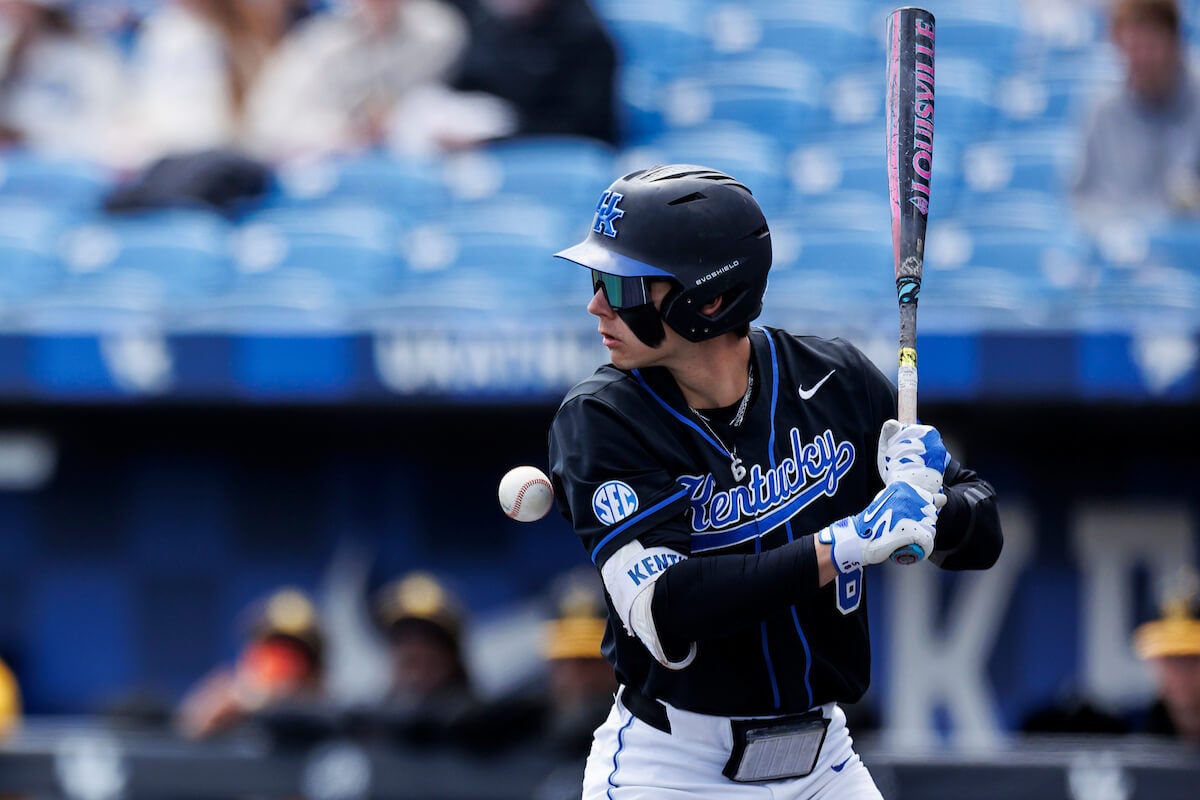
Mingione’s team stands for what it believes in more than just about any program in college baseball. Since the start of the 2025 season, Kentucky batters have been hit by a pitch on 6.21 percent of their plate appearances (275 total HBPs), the highest rate in the nation.
“We teach it,” he said. “We practice it. There is an art to getting hit.”
And more players are getting hit across the sport of college baseball. In 2019, HBPs occurred on 2.57 percent of plate appearances. That has increased every season since and is now at 3.50 percent in 2026 heading into the weekend.
There are two rather simple explanations for the increase.
“Pitchers don’t command whatsoever,” Troy coach Skylar Meade said. “Throwing strikes and commanding the baseball and being efficient pitch to pitch, it’s down as a whole.”
“More programs just in general are valuing the free pass, whether it be a walk or a hit by pitch,” said ESPN/SEC Network analyst Chris Burke, a former teammate with the Houston Astros of Craig Biggio, MLB’s all-time leader with 285 HBPs.
And Kentucky’s players are happy to sit back — or stand still, in their case — and take the free base.
“For us, it’s doing what it takes to win,” Mingione said. “And we value toughness over comfort. It takes real toughness and courage to stand in that box and wear a pitch for your team.”
Nobody in college baseball has been more courageous, to steal Mingione’s word, than JT Landwehr was in 2024. As a sophomore at Mount St. Mary’s, Landwehr broke a 10-year NCAA record by getting hit 39 times, or once every 6.2 plate appearances. That was a huge spike after he got plunked only seven times as a freshman.
“I got yelled at for getting out of the way my freshman year,” said Landwehr, now a senior at Portland. “I went into summer (ball), and I think I got hit a couple times, but something flipped in my head that I wasn’t gonna skate at all, and I didn’t. I genuinely didn’t get out of the way of a single pitch that entire season.”
Landwehr, fortunately, avoided significant injury, but that doesn’t mean it was a comfortable experience.
“My elbow was every color of the rainbow,” he said. “It was black, blue, purple, yellow, green, all up and down and under my biceps. It was pretty gnarly. The elbow pad absorbed a lot of the pitches, but getting hit in the same spot made it bruise big time.”
Landwehr embraced his run to the record book, telling teammates “it would be kind of funny if I just got hit all the time this year” after he got drilled five times in Mount St. Mary’s first three games.
“I started a count to 10, and then I got past 10 and it just kept happening.”
He finished the regular season with 37, tying the record set by Delaware State’s Scott Davis in 2010 and equalled by Vanderbilt’s Brian Harris in 2012.
Landwehr ended all drama in the third inning of the Mountaineers’ first Metro Atlantic Athletic Conference tournament game, getting hit on his left forearm on a 0-0 fastball. He slammed his bat down, gestured enthusiastically to his teammates and trotted to first as an NCAA record holder.
“Then, to put a cherry on top, I got hit in our semifinal game, as well,” said Landwehr, who, remarkably, has been hit only six times in 91 plate appearances in two seasons at Portland.
There’s a slight chance his 15 minutes of fame might soon be over. Tre Phelps, Georgia’s standout second baseman, could flirt with the record if the Bulldogs make a deep run in the NCAA Tournament. Phelps has 31 HPBs in 55 games and, at his current rate of 0.56 per game, would need to play 71 games (two shy of the maximum possible) to eclipse Landwehr’s 39 in 53 games (a much more prolific 0.74 per game). But it’s worth noting that Phelps’ HBP rate is “only” 0.42 vs. SEC teams, and he will face SEC-caliber pitching in almost every game the rest of the way.
“I don’t like getting hit by the ball, but the ball likes hitting me,” Phelps told reporters in April. “It’s kind of crazy to see.”
UCLA shortstop Roch Cholowsky, expected to be the No. 1 pick in the 2026 MLB Draft, won’t threaten the single-season record — he has 23 in 2026 and 44 over the last two seasons — but he’s a bit of an anomaly as a top prospect who is among the league leaders in HBPs. There are 12 college hitters in Keith Law’s most recent first-round mock draft; only three others have been hit more than 10 times (and only two who don’t play for Kentucky).
Landwehr acknowledges he would be “a little bit bummed” if Phelps breaks his record, but “it would be impressive if someone got hit 40 times in one season.”
You know what’s also impressive. Not getting hit a single time in 72 games and 316 plate appearances — something former Michigan third baseman Jimmy Kerr accomplished in 2019 during the Wolverines’ run to the College World Series finals.
“I can’t say it’s something I’m proud of because it is a free base and there are probably many times I ended up getting out after getting out of the way,” said Kerr, who is now an agent at Excel Sports Management.
“But I wouldn’t say I tried not to get hit. For some reason, I just always had the ability to get out of the way.”
Kerr, clearly, never had to be concerned about violating NCAA Rule 8-2.1, which basically says that a batter doesn’t have to get out of the way, but that he can’t lean into the pitch.
Landwehr, proudly, has never been called for intentionally getting plunked.
“Never once,” he said. “There was some controversy in the conference tournament. They reviewed one. But I didn’t move. I stand there and just take it.”
The interpretation of that rule has caused much angst for Mingione over the years.
“I’ve been ejected multiple times,” he said, “for our guys getting hit and the umpire not awarding him first base for whatever reason. If you want to see me get fired up, have an umpire not call the HBP right. It’s going to fire up coach Mingione.”
Mingione cringed when asked if any of his players had gotten hurt by a hit by pitch.
“This is like talking about the no-hitter,” he said. “Do they get hurt? Have they missed games in long periods of time? No.”
And there are exceptions to the “We don’t move!” mantra.
“There are times in life where you do have to move,” Mingione said, “and you have to make adjustments. So if the ball ever comes at our head or our hands, we move.”
Mingione maintains he has never received pushback from other coaches in the SEC about his team’s “willingness” to get hit.
“Never. They know,” he said. “And here’s the beauty of this: Not only do they know, their players know. Their players know that we don’t move. And it’s an absolute, 100 percent in my mind, it creates a competitive advantage.”
Coastal Carolina used the hit by pitch to its advantage en route to the College World Series finals last season. The Chanticleers led the nation with 179 HBPs, including 19 in 10 NCAA Tournament games.
Coastal is once again among the nation’s leaders — third with 133 — and is a lock to return to the NCAA Tournament.
Kentucky is an anomaly as one of the few teams on the HBP leaderboard that did not finish near the top of its conference. The Cats went 13-17 in the SEC, but will still likely play in the NCAAs for the fourth consecutive season.
Mingione has to be one of the few coaches nationally who values HBPs when scouting players in the transfer portal. Last offseason, Kentucky signed infielder Tyler Cerny, who set the Indiana program record with 45 HBPs in his three seasons with the Hoosiers. This season, he’s been plunked 11 times in only 96 plate appearances.
So the (rhetorical) question had to be asked:
Would you rather have a player hit 20 home runs or get hit by a pitch 20 times?
“The home run is the greatest play in baseball,” Mingione said. “You can’t defend it and you score a run. So, I’m taking a home run every time.