MLB
The Astros insist they’re buyers. They didn’t play like it against Baltimore
Source
nytimes.com
HOUSTON — Of the 149 major-league players who’ve logged at least 100 competitive runs, only five have a slower sprint speed than Pete Alonso. The lumbering slugger can still seize advantage of apathy, so in the third inning of a sleepy Sunday matinee at Daikin Park, he tried to steal second base.
Alonso stole two bases across his first 96 games as a Baltimore Oriole. On Saturday, he swiped his third. Perhaps that should’ve heightened someone’s alert on Sunday, be it Houston Astros ace Hunter Brown, his personal catcher Yainer Diaz, the makeshift middle infield playing behind them or anyone else within a team trying to prove it deserves meaningful additions at the upcoming trade deadline.
“What they do in the front office is what they do,” closer Josh Hader said. “If they decide they want to get players, bring them in — reinforcements — and make us a better ballclub, that’s a winning attitude.”
Seeing that from the existing group should be a prerequisite, perhaps even the impetus needed to improve a team treading water in a woebegone American League.
Instead, across 29 abysmal innings this weekend, the Astros played with the antithesis of a “winning attitude.” They stranded 28 baserunners, surrendered 23 free passes, struck four extra-base hits, squandered two winnable games, sunk to seven games below .500 and raised serious questions about their status as aggressive buyers.
“Obviously it’s not what we envisioned,” said Brown, who failed to finish six innings for the fourth time in six starts since coming off the injured list. “You want to come out of the break and get on a nice little run. We haven’t done that.”
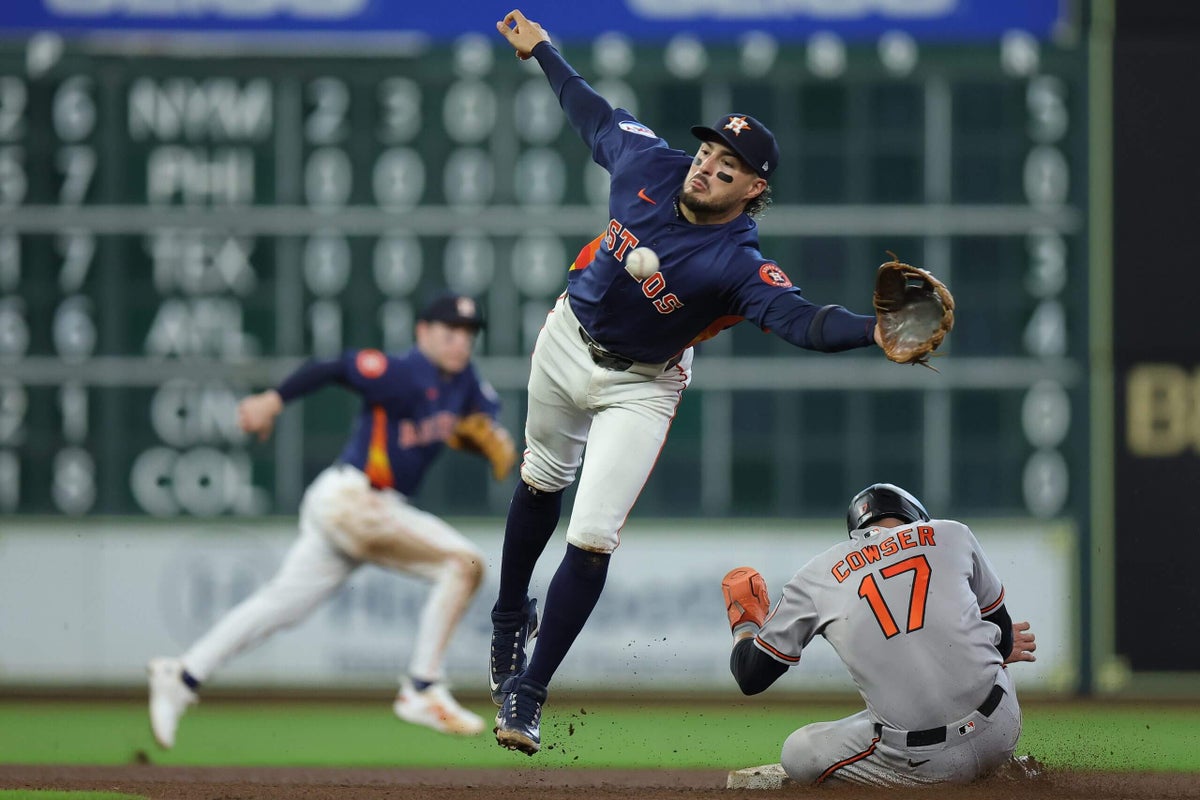
On Sunday, Brown paid Alonso no attention while he drifted off first base and headed toward second. Gunnar Henderson stood on third base, but Diaz threw down to second anyway. Henderson, mind you, scored the go-ahead run in Saturday’s game after Diaz vacated home plate on a routine chopper that second baseman Jose Altuve could not convert into an out.
Altuve received a rare start at designated hitter on Sunday, so Ray Delgado caught Diaz’s ill-advised throw. Delgado applied the tag on Alonso far too late and argued with second-base umpire Eric Bacchus to the contrary. Henderson scored Baltimore’s second run while Delgado did.
Houston scored two or fewer runs in every game of this series. It played Sunday’s game without Christian Walker or Jeremy Peña, too, so the blunder became a death knell. Enough blame for it exists to go around. Diaz deserves most of it — and Astros coaches discussed it with the catcher afterward — but divvying it out may distract from a bigger point.
“We’re worried about winning games — winning at-bats, winning strikes and trying to execute pitches,” Hader said of a team that did none of that. “I think if we put all those pieces together, we’ll put ourselves in a good position.”
Fifteen days and 12 games before the trade deadline, this is the state of an Astros team that still fancies itself a championship contender. Being in the American League can help to verify its claim, but a shrinking calendar is removing the luxury of relying on others’ mediocrity.
Sunday’s loss left Houston four games back in the AL West and 4 1/2 games behind the Boston Red Sox for the final wild-card spot, with three other teams between Houston and Boston in the standings. According to FanGraphs, the Astros were among 12 American League teams that awoke on Sunday with at least a 15 percent chance to reach the postseason. Houston had the lowest odds among them.
“We got 61 games left. There’s a big race in the AL right now for us to make way. To win some games early out of the break would definitely help, but 61 games left,” Hader said. “I think we can still make way. We obviously have to play better baseball. The longer it goes on, the more the games matter.”
Few in this franchise’s recent history feel more significant than the next 15, across which the Astros must demonstrate whether they are worth meaningful upgrades at the Aug. 3 trade deadline. The urgency is obvious.
General manager Dana Brown has insisted the team will be buyers, but he is working in the final year of his contract. So is Espada. Both men must save face and try to save themselves, so saying anything to the contrary is illogical, especially if they hope to keep this clubhouse intact.
Owner Jim Crane, who called veteran starter Lance McCullers Jr. earlier this week and asked him to waive his no-trade clause, still influences baseball operations decisions. Houston’s choice to trade McCullers in the first place came as it pursued ways to pare its luxury tax payroll — in preparation for deadline additions.
“I don’t see Jim not wanting to win games,” said Hader, who is playing on the most lucrative free-agent contract of Crane’s ownership tenure. “He’s a winner. He’s won for a long time here in this organization.”
That has been the theme of Crane’s entire reign. He has reiterated that Houston’s championship window will not close while he owns the team. Crane has fulfilled that promise during every trade deadline.
Expecting Crane to do anything different this time around feels foolish, but this is also the first team he’s overseen since 2014 with a losing record through 100 games. It needs help at so many positions — starting rotation, right-handed relief and outfield foremost among them — and even with all those areas addressed would still be depth-starved. Adding something to help is sensible, but whether this is a club worth pushing all in to augment is a legitimate question.
Given Brown’s contract status and Crane’s unmatched aggression, does the answer really matter?
“We’ve had some nice, heated debates as to what we’re going to do going forward in terms of making this team better,” Brown told the team’s pregame radio show on Sunday.
“It’s a full sprint right now. There’s no room to give. There’s no runway for anyone right now. If you can’t get it done, we really have to make some decisions and some of these decisions are going to be tough decisions.”
One arrived after Sunday’s game. The team optioned Bryan King, their season-long setup man, to Triple-A Sugar Land. King surrendered the go-ahead runs in three of Houston’s past five losses. Before he did, King boasted a 2.03 ERA in 40 innings, but gone are the days of ample runways.
And, if the next 15 games are not better than the past three, more decisive action may be in the offing.
“(If) they want to sell guys and look long-term, that’s another thing, but we have no control over that,” Hader said. “Our control is showing up every day, giving it everything and winning ballgames. I think if we can stick to that, they’re going to put us in a good position to continue to win games.”